Australia’s Welding Fume Exposure Standard: Is Your Respirator Still Adequate?

Australia’s Welding Fume Exposure Standard: Is Your Respirator Still Adequate?
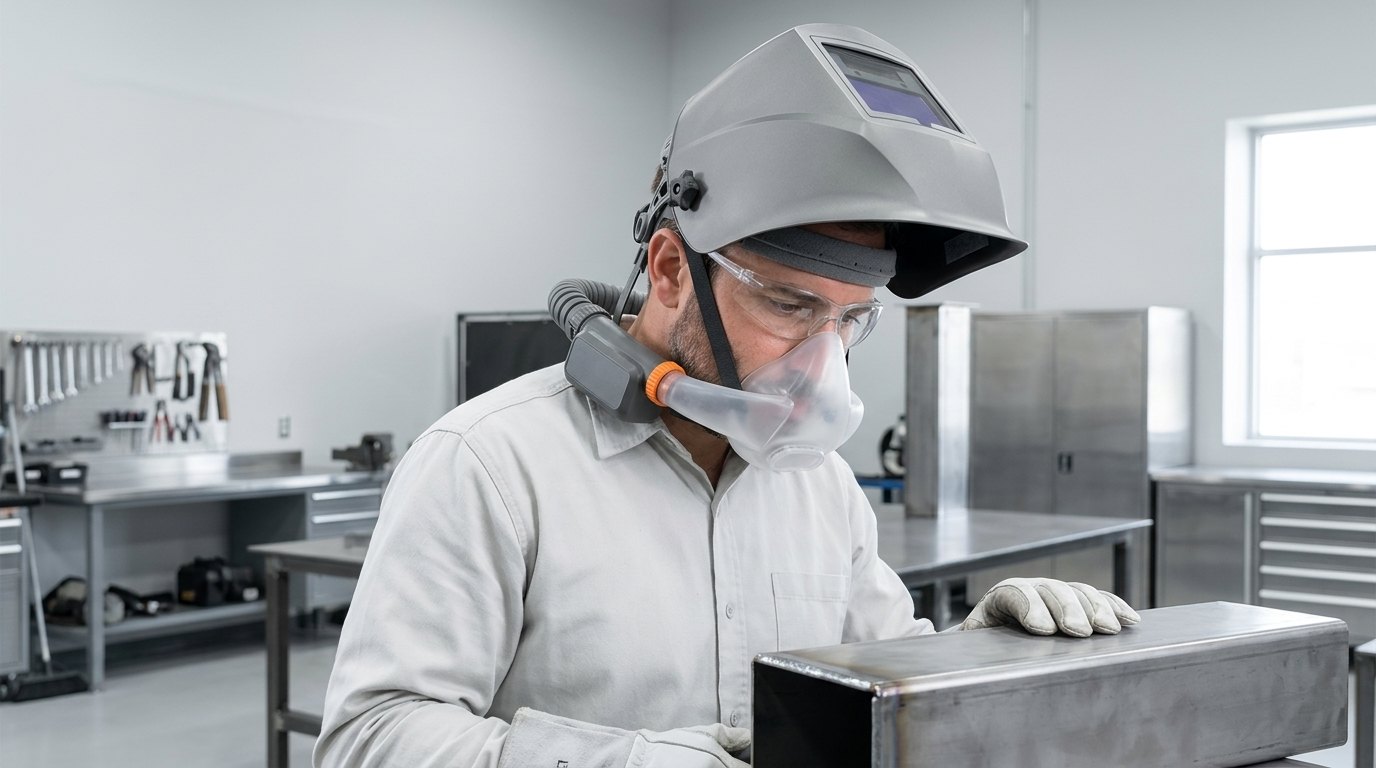
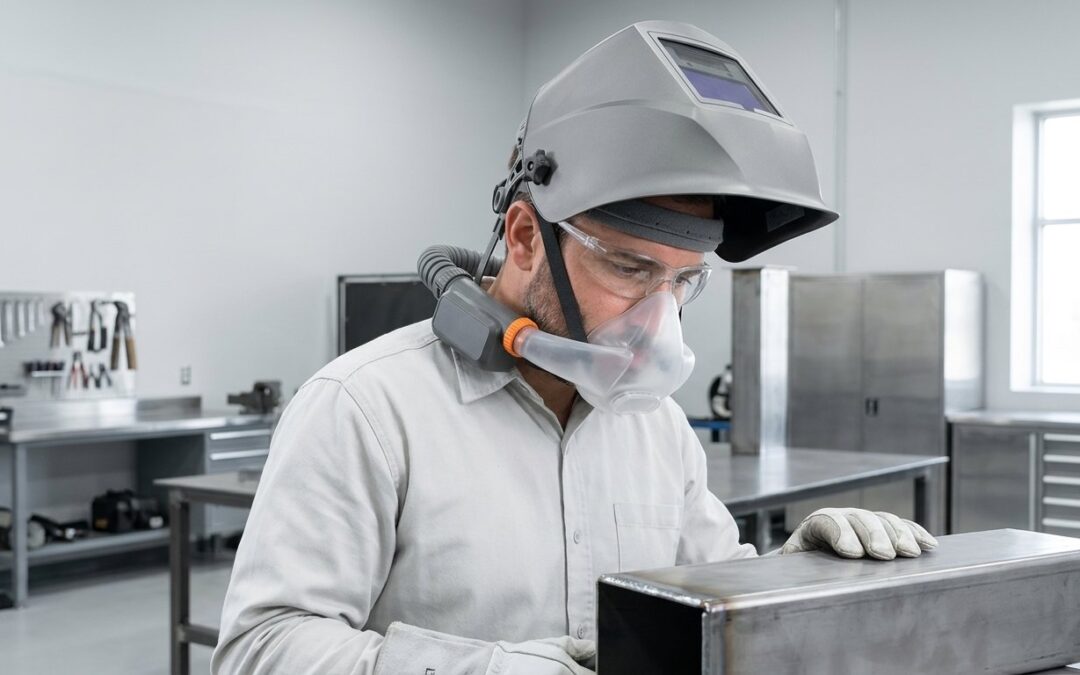
Illustration of a fabrication worker inspecting a completed weld while wearing an around-the-neck powered air purifying respirator

What the 1 mg/m³ limit means for exposure monitoring, control measures and respirator selection.

The welding fume exposure standard in Australia for welding fumes not otherwise classified (NOC) is 1 mg/m³ as an eight-hour time-weighted average (TWA). Employers also need to assess individual fume components and any gases against their own applicable limits. Safe Work Australia explains the current standard.

A lower exposure limit does not automatically make your current respirator inadequate. It does mean you should review whether your exposure controls and selected respirator provide adequate protection for the welding work you do.

This guide explains Australia’s 1 mg/m³ welding fume exposure standard, when air monitoring is required, and what to review when assessing your existing respiratory protection. It draws on national guidance, with clearly identified Victorian examples.

Key takeaways

  • Use the current 1 mg/m³ welding fume standard when reviewing exposure to welding fumes NOC, alongside applicable limits for individual contaminants.
  • Check monitoring requirements when exposure is uncertain on reasonable grounds or monitoring is needed to assess a health risk.
  • Review exposure controls before deciding whether the respiratory protection already in use is sufficient.
  • Prepare for the WES to WEL change on 1 December 2026 and check the applicable list with your regulator.

References: welding fumes, air monitoring duties, exposure standards and limits.

What the 1 mg/m³ welding fume standard means

The unit mg/m³ means milligrams per cubic metre of air. An eight-hour TWA expresses exposure averaged over an eight-hour working day, with a 40-hour working week as its reference. A short reading beside a welding bay is not the same measurement. Longer shifts and overtime need appropriate interpretation; an occupational hygienist can advise. See WorkSafe Victoria on exposure standards and monitoring.

Safe Work Australia makes clear that exposure standards are statutory upper limits, not acceptable exposure levels or a guarantee of safety. Welding fume exposure must still be eliminated or minimised so far as is reasonably practicable. For people who weld regularly, respiratory protection should provide an adequate level of protection for the assessed exposure and be suitable for the task and duration of use, alongside effective fume controls. WorkSafe Victoria explains how to select appropriate respiratory protection.

A total-fume result also does not establish compliance for every constituent. The metals, consumables and coatings involved can change the mixture, so the assessment needs to cover relevant individual contaminants. Safe Work Australia describes these separate duties.

When the Australian welding fume exposure limit changed

On 18 January 2024, Safe Work Australia announced that WHS ministers had agreed to reduce the welding fumes NOC standard from 5 mg/m³ to 1 mg/m³. Its notice says the change becomes mandatory when implemented through Commonwealth, state or territory WHS/OHS laws. Check the regulator for the jurisdiction in which the work takes place. Read the national announcement.

Victoria announced that its change took effect on 18 January 2024. Its notice urged employers to reassess their controls. This confirms the Victorian date; it should not be used as proof that every jurisdiction implemented the change on exactly the same day. Read the Victorian announcement.

Aluminium welding fumes have a separate entry. Safe Work Australia’s information sheet gives 17 November 2025 as the reduction date for that entry, also from 5 mg/m³ to 1 mg/m³. Keep this distinct from the January 2024 NOC change. Read the aluminium information sheet.

What changes in December 2026

As at 30 September 2026, the Workplace Exposure Standards (WES) list remains applicable. From 1 December 2026, the Workplace Exposure Limits (WEL) list replaces it. The change includes revised limits for a range of substances, so workplaces should check the entries relevant to their processes rather than treating it as a name change alone. Safe Work Australia’s current transition guidance and WorkSafe Victoria’s explanation set out the timing.

When reviewing welding work, keep the total-fume assessment and the assessment of individual contaminants together. Confirm the applicable requirements with your regulator as the transition approaches.

Why the exposure standard was reduced

Welding fume exposure can damage health over time as well as cause immediate irritation. WorkSafe Victoria’s January 2024 notice lists respiratory irritation, asthma, metal fume fever, nervous-system damage and cancers among the possible effects. Read the regulator’s health explanation.

The reduced standard makes older control assessments worth revisiting. A result below 5 mg/m³ may still be above 1 mg/m³. It does not follow that every respirator selected before 2024 must be replaced; the question is whether the whole control arrangement remains adequate for the current exposure and applicable limits.

What Western Australian mining samples show

A 2025 study by Oosthuizen and colleagues analysed 10,843 welding fume samples collected in Western Australian mining between 1986 and 2024. For the 4,035 samples from 2018–2024, the researchers reported the following comparison. Read the study and Table 3.

  • Against 1 mg/m³: 2,814 samples exceeded the standard, or 69.7%.
  • Against 5 mg/m³: 865 samples exceeded the former standard, or 21.4%.
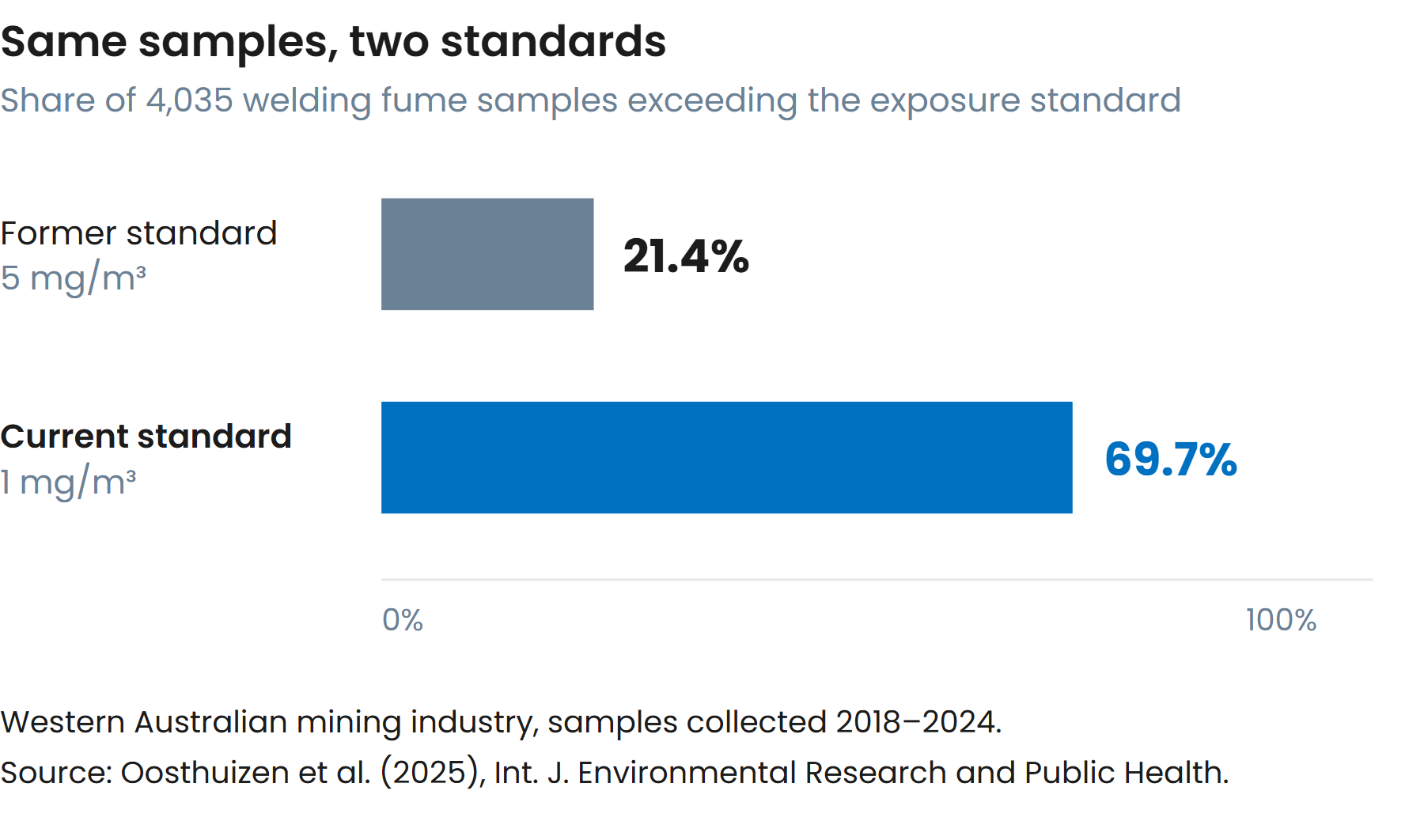
Bar chart: 69.7 per cent of 4,035 Western Australian mining welding fume samples exceed the current 1 mg/m3 standard, against 21.4 per cent under the former 5 mg/m3 standard

These are historical WA mining samples, not an estimate for all Australian welding workplaces today. The authors also note that sampling outside respiratory protection may not reflect the exposure of a worker who is adequately protected, and other nearby dust sources can affect the samples. The results justify reviewing controls; they do not prove that seven in ten welders are unprotected. Study discussion and limitations.

Welding fume monitoring requirements in Australia

Safe Work Australia describes two triggers for air monitoring where an exposure standard applies: uncertainty on reasonable grounds about whether airborne concentrations exceed the standard, or a need to determine whether there is a risk to health. Monitoring is therefore tied to the exposure assessment, not simply to whether a business owns welding equipment. Read the national air monitoring guidance.

Victoria’s welding guidance identifies a comparable duty under regulation 166 of its OHS Regulations. That regulation number is Victorian and should not be presented as a nationwide provision. Read the Victorian welding guidance.

Use a competent person, such as an occupational hygienist, to plan representative personal sampling and interpret the results. Fixed-position measurements can help investigate conditions in an area, but should not be substituted for personal exposure measurements. WorkSafe Victoria explains the distinction.

Give the hygienist your existing reports, welding processes, materials, consumables, work patterns and current controls. Ask whether the previous measurements still represent today’s work, and which constituents need assessment. Safe Work Australia’s monitoring guidance explains how results help assess control effectiveness.

Which exposure controls to review

Start with opportunities to eliminate welding or reduce fume generation through appropriate process and consumable changes. Review separation of welding work from others and engineering controls, including on-torch extraction or local exhaust ventilation. SafeWork NSW advises that general natural ventilation should not be relied on as the primary control for welding fumes. Read SafeWork NSW’s control guidance.
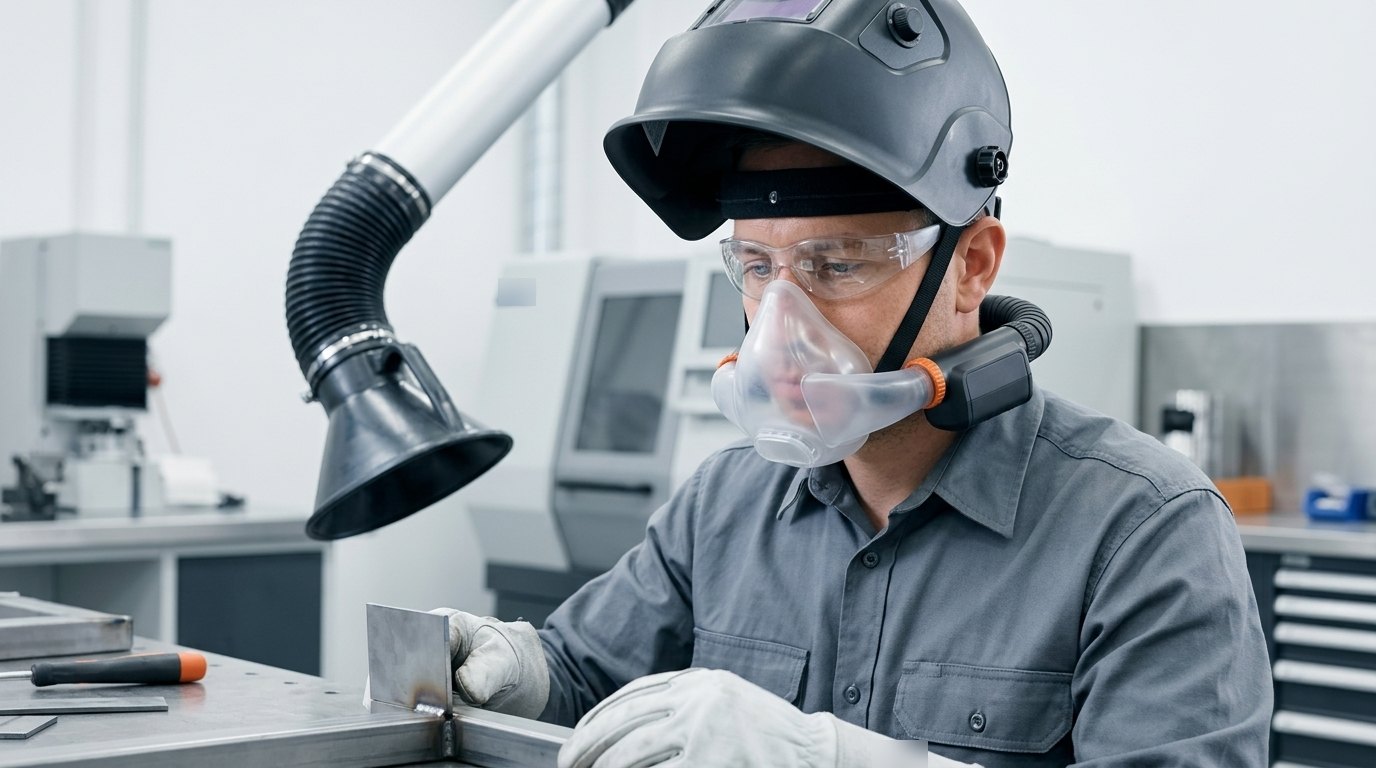
Illustration of an articulated local exhaust ventilation arm over a welding bench, with the fabricator also wearing an around-the-neck powered air purifying respirator

Keep respiratory protection in that wider control plan. WorkSafe Victoria describes RPE as a lower-order measure for supplementing controls, use where higher-order measures are not practicable, or interim protection while those measures are implemented. RPE does not remove fume at its source or protect everyone nearby. Read the Victorian RPE guidance.

To explore how extraction and respiratory protection fit together in practice, read our guide to welding fume protection. It introduces protection options and the AYO WX HFM-W PAPR design, helping you prepare product questions alongside your workplace exposure assessment.

If your assessment calls for a powered respirator for welding, see the HFM-W welding half-mask PAPR for available configurations and product documentation.

How the exposure limit affects respirator selection

A respirator must suit the contaminants, exposure level, task and other controls in place. WorkSafe Victoria’s guidance refers to AS/NZS 1716:2012 or its equivalent and calls for instruction and training in fitting, use and maintenance. Read the regulator’s respirator guidance.

WorkSafe Victoria lists the types of RPE that may be suitable for welding in order of effectiveness:

Order Respirator type What the guidance says about facial fit
1 Powered air purifying respirator (PAPR) Described as available as part of a welding shield or helmet, and as not relying on a facial fit
2 Half-face cartridge respirator with P2 or P3 cartridges “The wearer needs to be clean shaven to ensure a good facial seal”
3 P2 disposable respirator “The wearer needs to be clean shaven to ensure a good facial seal”

A particulate filter alone does not protect against gases such as ozone or nitrogen oxides. SafeWork NSW also distinguishes the fit requirements of tight-fitting respirators. Selection must address the actual facepiece and filter configuration; a general reference to PAPR does not establish that a particular device is suitable. Read SafeWork NSW’s RPE guidance.

Respiratory protection for welders with facial hair

Where facial hair interferes with a tight-fitting respirator’s seal, suitable respiratory protection that does not rely on that seal is needed, such as an appropriate loose-fitting PAPR. WorkSafe Queensland explains facial hair and respirator selection.

The AYO WX HFM-W P-Boost is certified to EN 12941:2023, class TH3 P, as a powered filtering device incorporating a loose-fitting respiratory interface. View the HFM-W P-Boost certificate and its annex. Selection should still account for the welding hazards, required protection level and manufacturer’s instructions.

Considering the AYO WX HFM-W PAPR for your workplace

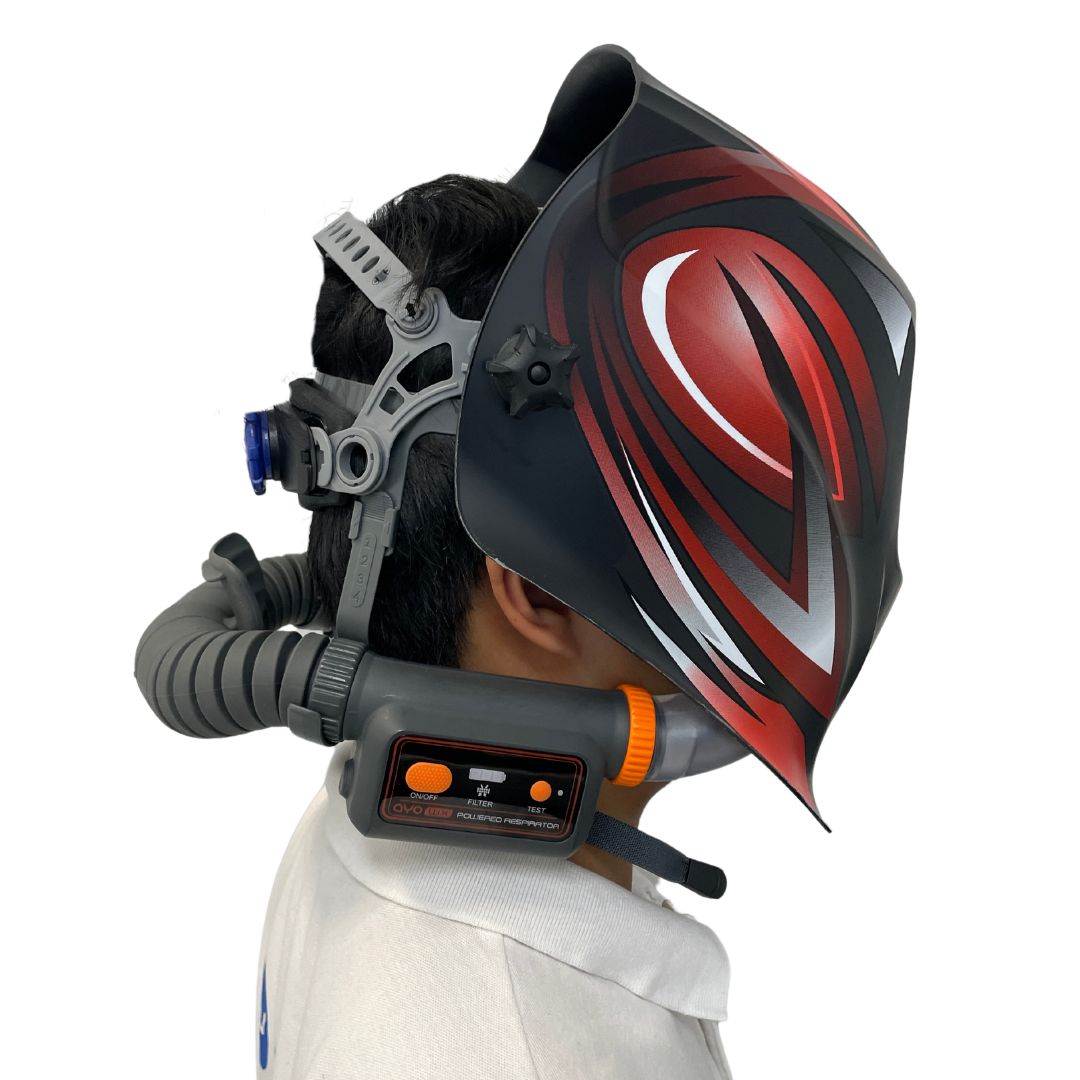
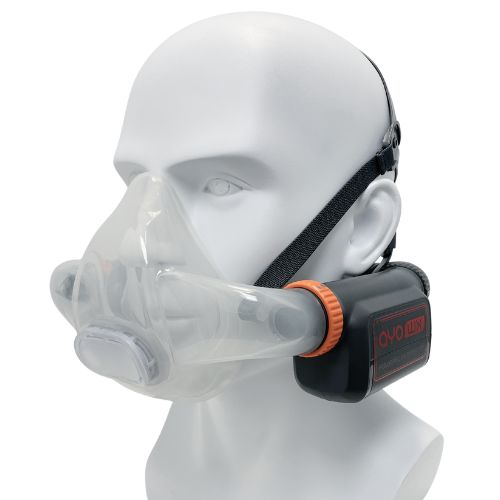
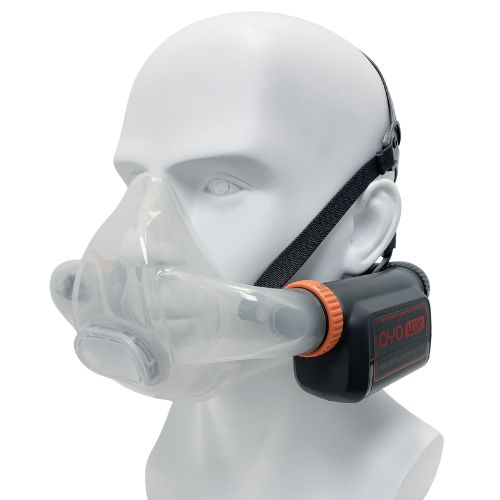
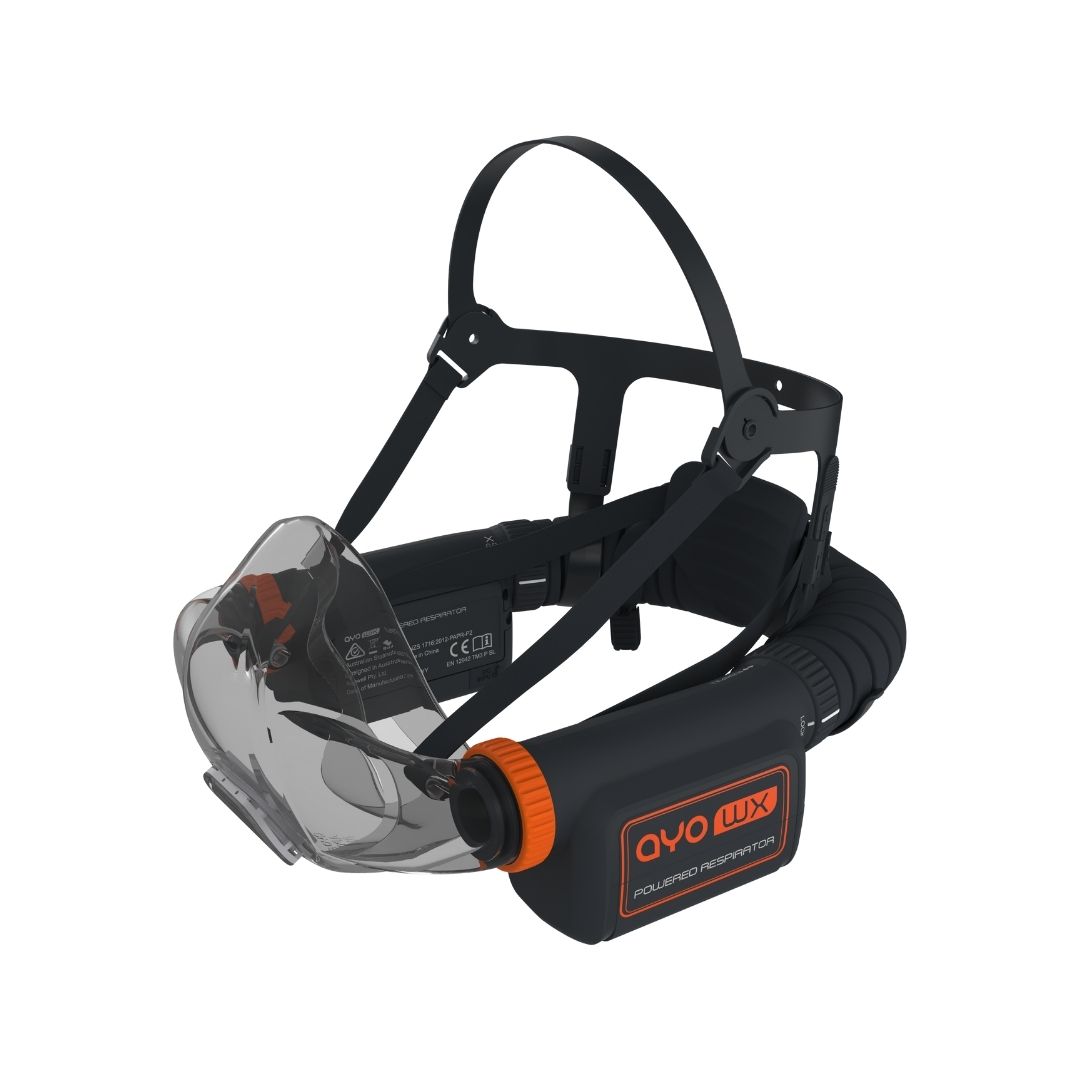
At Aimwell, our AYO WX HFM-W welding PAPR system uses an around-neck main unit without a belt or hose. Its streamlined half-face mask is designed to work with most common welding helmets, allowing welders to retain a compatible existing helmet. Check the fit of the complete combination before selecting it for your team. For a discussion of equipment layout, read our comparison of PAPR wearing arrangements.
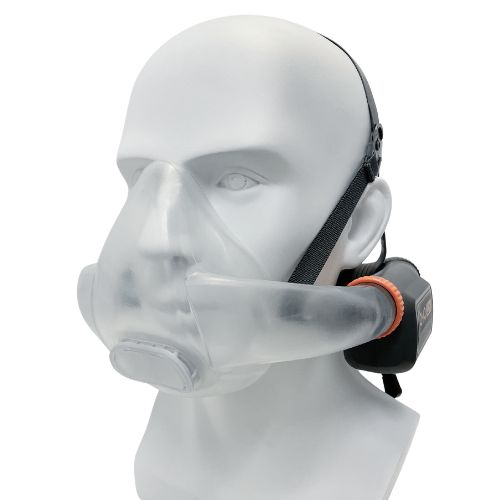
AYO WX HFM-W P-Boost welding half-face mask PAPR system on a head form AYO WX HFM-W P-Boost worn under a welding helmet

The AYO WX HFM-W PAPR range offers two main-unit options. P-Boost uses a pre-filter and a particulate main filter. The Gas option combines a particulate filter with a selected gas cartridge. The distinction matters when an assessment identifies gas or vapour hazards alongside fume particles: cartridge selection must match the identified contaminants and conditions. The Gas name alone does not establish protection against every gas produced by welding.

Use the product page to review configurations and manuals, and consult our AYO WX certification documents for the relevant system. Work through the choice with your occupational hygienist, including facepiece fit, filter suitability, maintenance and training. We can discuss product options once you have identified the protection your work requires.

Contents of the AYO WX HFM-W P-Boost welding PAPR package

A practical workplace review checklist

Use these questions to organise your review with the person responsible for workplace safety and your occupational hygienist:

  1. Do our reports compare results against the applicable current limits, including individual fume constituents?
  2. Do previous measurements represent our current welding tasks, work patterns and controls?
  3. Is there uncertainty that requires monitoring, or an identified exposure problem requiring improved controls?
  4. Have we reviewed extraction and other higher-order measures before relying on RPE?
  5. Does the selected respirator configuration match the assessment, with appropriate fitting, training and maintenance?
  6. Have we planned the review of relevant WEL entries before 1 December 2026?

Keep the assessment and resulting actions with your workplace records. Use your jurisdiction’s regulator for legal requirements and a competent occupational hygienist for site-specific exposure assessment. The linked official guidance above provides the basis for this review.

Discuss your welding respiratory protection with Aimwell

Reviewing your respiratory protection following an exposure assessment? View AYO WX HFM-W PAPR configurations and product details, or explore the AYO WX PAPR range. Tell us about your welding processes, helmet, identified contaminants and the findings of your exposure assessment so we can discuss the available configurations with you.

You can also email info@aimwellbreathing.com or call (02) 7251 8689. We can help with product information; your occupational hygienist and workplace safety team determine the protection required for the job.
Do PAPRs Need Fit Testing? Australian Training Requirements

Do PAPRs Need Fit Testing? Australian Training Requirements

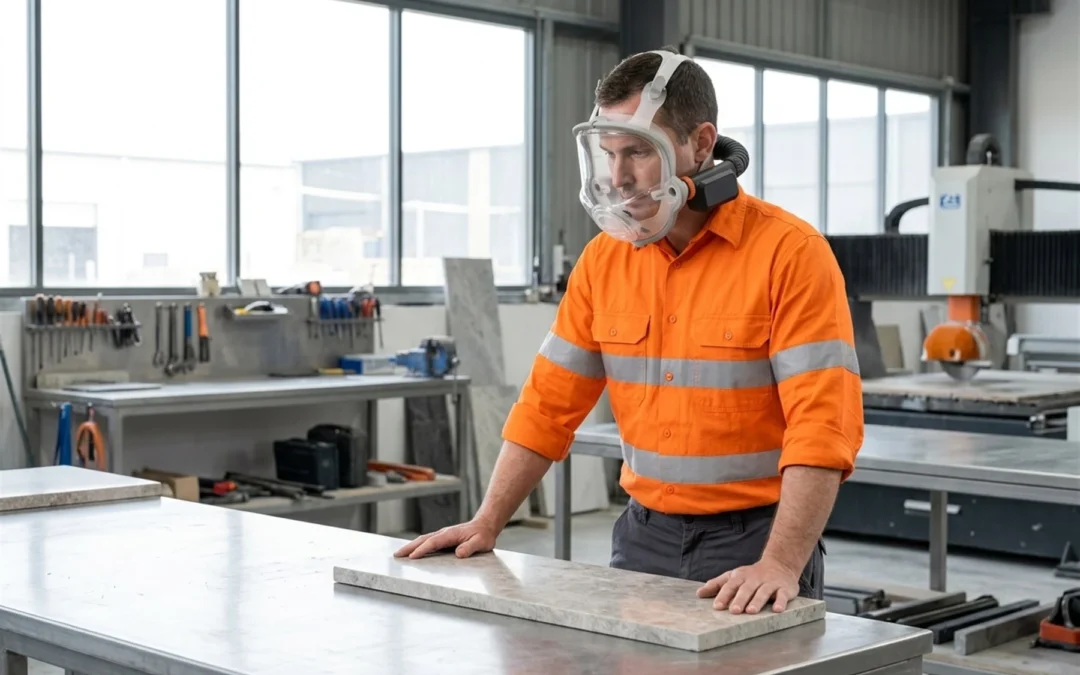
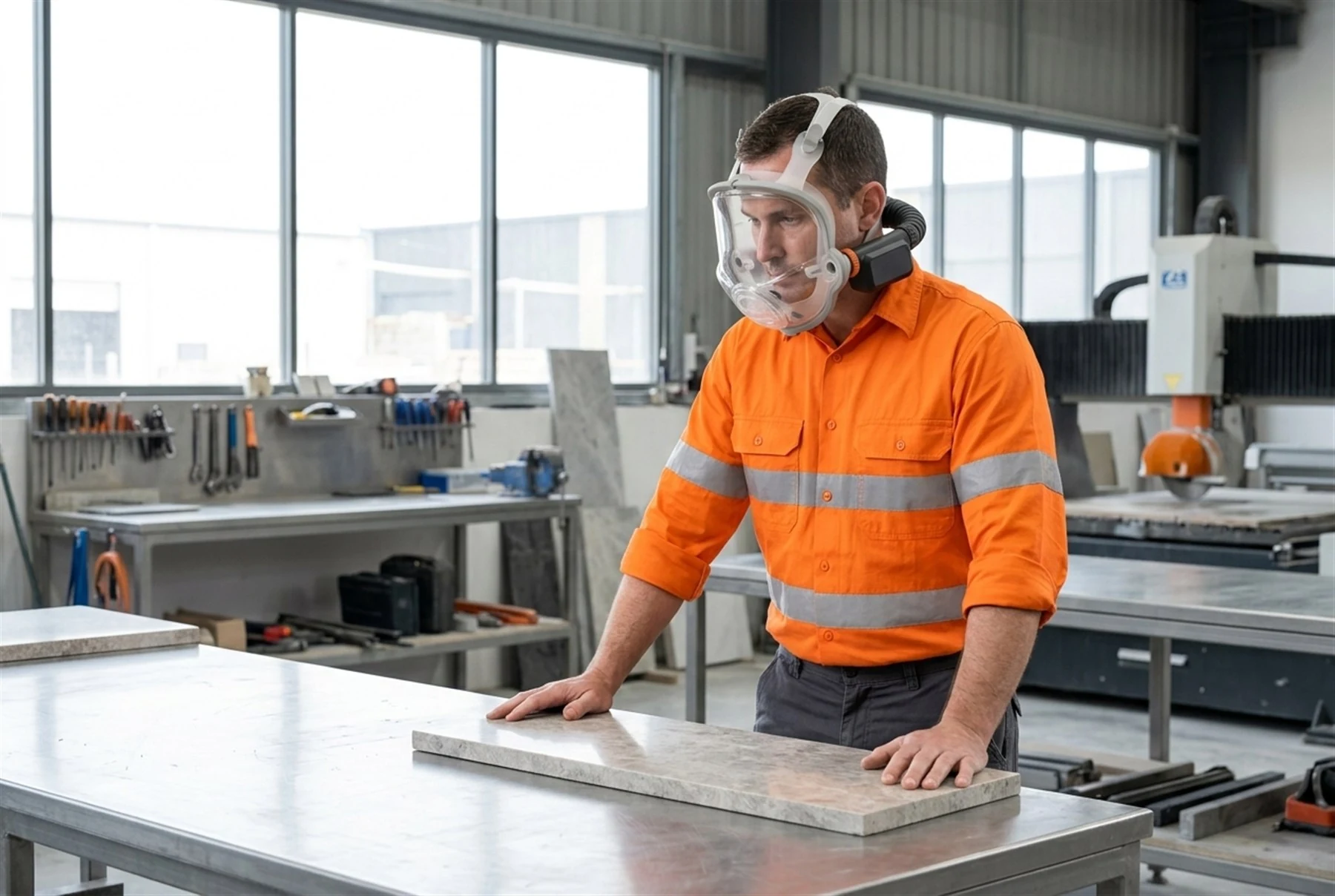
Illustration of a stone benchtop worker in a bright, well-controlled workshop wearing an around-the-neck full-face powered air purifying respirator

Buying a certified PAPR alone does not automatically make your workplace compliant. Under the model WHS Regulations, the duty to train workers in the proper use, wearing, storage and maintenance of respiratory protective equipment sits with the PCBU. That is a separate obligation from the certification the manufacturer holds.

That gap catches out a lot of well-intentioned safety programs. A site buys good equipment, files the certificate, and assumes the box is ticked. A regulator asks for training records, fit test records and a maintenance log, and there are none.

Key Takeaways

  • Device certification (AS/NZS 1716) and program compliance (AS/NZS 1715) are different obligations. No product can hold the second for you.
  • Model WHS Regulation 44 puts the duty to train, and to keep the equipment usable, on the PCBU.
  • Close-fitting respirators need fit testing before first use, on any change of make, model or face, and at least annually — clean-shaven.
  • Fit testing is not required for positive-pressure loose-fitting facepieces — and loose-fitting is not limited to hoods and helmets. A dual-fitting facepiece is certified both ways: worn loose-fitting, no shaving and no fit test; worn tight-fitting, higher protection once it is fitted.
  • Name the framework with any protection factor: TH3 is 500 nominal under EN 12941 and APF 40 in the UK. Australia works from a required minimum protection factor under AS/NZS 1715 — a different kind of number, keyed to the facepiece. Never mix the three.
  • Welding fume fell to 1 mg/m³ in January 2024. Respirable crystalline silica is 0.05 mg/m³ over eight hours.

Jurisdiction: this describes the model WHS Regulations. Victoria uses its own OHS Act 2004 but adopts the same exposure standards — check each duty separately. NSW-specific duties are marked below.

Does an Australian employer legally have to train PAPR users?

Yes. It is not optional, and it is not satisfied by handing over a manual. The PAPR training requirements come from the model WHS Regulations, not from the equipment.

Under the model WHS Regulations, a PCBU that provides personal protective equipment must give workers information, training and instruction in the proper use and wearing of that equipment, and in its storage and maintenance.

Regulation 44 goes further than training. The PPE itself must be:

  • Selected to minimise risk to health and safety
  • Suitable for the nature of the work and the hazard
  • A suitable size and fit
  • Reasonably comfortable for the worker wearing it
  • Maintained, repaired or replaced so it keeps working

Read that list again with a crew in mind. Reasonably comfortable is a legal requirement, not a nicety. If workers loosen or remove a respirator because it is unbearable in heat or makes communication impossible, the equipment is not minimising risk — and the duty is not discharged.

This is not a theoretical concern. We have written separately on why paper masks and non-powered respirators fall short in high-exertion work, where the wearer’s own breathing effort is the limiting factor.

Which standard sets the training requirement — AS/NZS 1715 or AS/NZS 1716?

AS/NZS 1716:2012 AS/NZS 1715:2009
What it governs The device Your program
Who holds the duty The manufacturer The employer (PCBU)
Can a product be certified to it? Yes No
Covers training? No Yes
Covers fit testing? No Yes
Covers maintenance and records? No Yes
What you should ask for A certificate number Your own records
The CMI ProdCert certification mark carried by AYO WX respirators certified to AS/NZS 1716:2012 under certificate PC10112

The CMI ProdCert mark indicates certification of the device to AS/NZS 1716:2012. It says nothing about your program.

No product can be certified to AS/NZS 1715:2009 — Selection, use and maintenance of respiratory protective equipment. It describes what the employer must do. AS/NZS 1716:2012 certifies the device; Aimwell holds PC10112 to it, issued by CMI Certification Pty Ltd.

A respiratory protection program addresses the whole lifecycle, not just the purchase. SafeWork NSW describes the employer’s obligation as providing “a program to correctly fit, instruct on use and ensure regular maintenance of respiratory protective equipment (RPE)”.

AS/NZS 1715 is not freely available. You will need a copy, or advice from someone who has one, to work to it clause by clause — which is the honest reason so many programs are built on second-hand summaries rather than the text.

The practical test: if a regulator asks how you know a respirator worked on a particular worker on a particular day, the certificate cannot answer that. Your program records can. Certification tells you the device can protect. Your program is what proves it did.

What we put in PAPR training

The regulation requires “information, training and instruction in the proper use and wearing… and its storage and maintenance”. It does not enumerate topics. The list below is the one we use with our own customers — a practitioner’s checklist, not a statutory one:

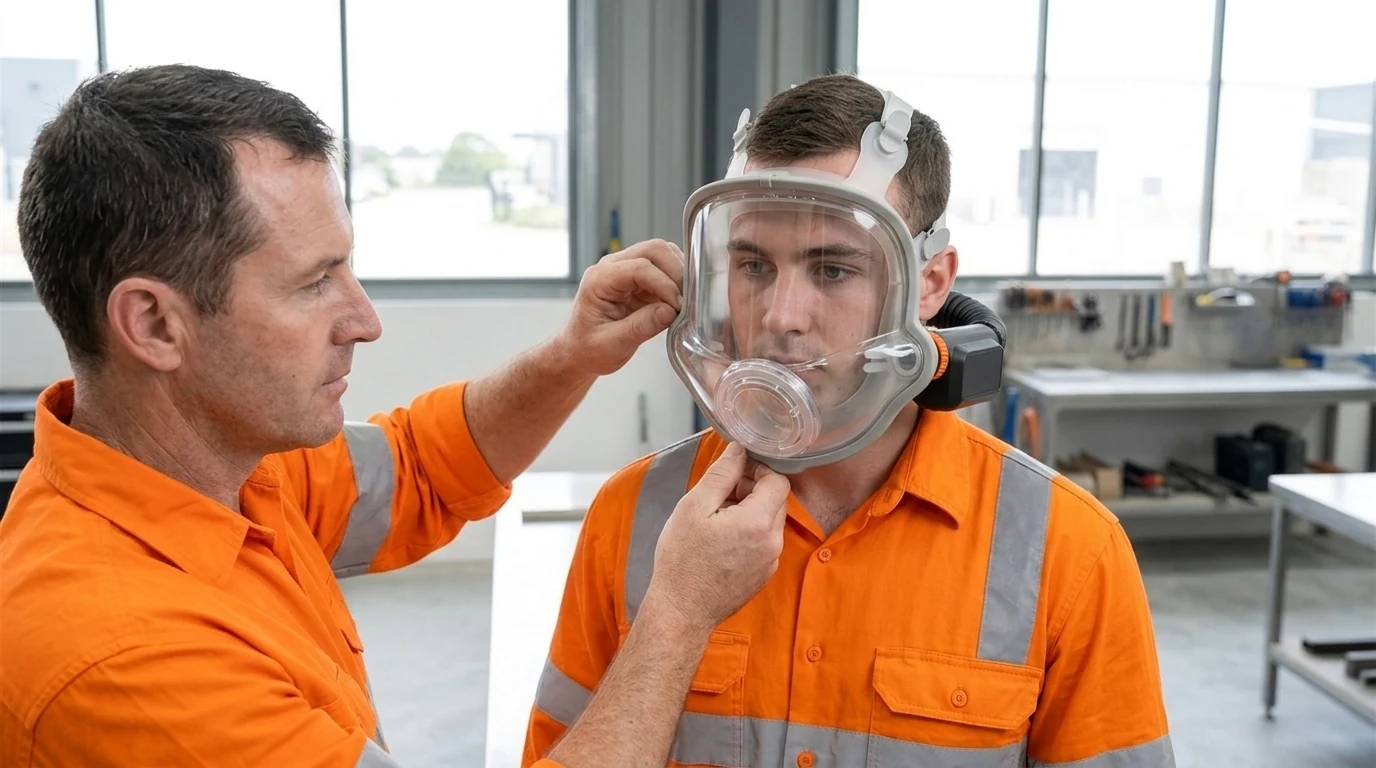
Illustration of a supervisor checking the facepiece seal on a worker wearing a full-face powered air purifying respirator
  • What the respirator protects against, and what it does not. A P3 particulate filter does not protect against gases or vapours. Workers should know the limit of their own equipment.
  • Pre-use checks. Battery charge, airflow check, filter condition and seating, facepiece integrity, breathing duct and connections.
  • Donning and doffing. Including how to remove contaminated equipment without contaminating yourself or others.
  • Airflow alarms and what to do when one sounds. Leaving the contaminated area is the answer; workers need to know that before it happens.
  • Filter and pre-filter change intervals, and how to tell when a change is due.
  • Cleaning, storage and battery care. Regulation 44 makes storage and maintenance an explicit part of the training duty.
  • Who to report a fault to, and what happens while the unit is out of service.
  • How to communicate while wearing it. If crews cannot make themselves understood, they will lift the facepiece. Built-in speech diaphragms help; the AYO WX HFM-SP speech-enhanced system exists for sites where that is the binding constraint.

Review training when the work changes, when new equipment is introduced, or when a worker moves to a different task. It is not a one-off induction item.

Video demonstrations help this stick, particularly for donning, doffing and filter changes. Our AYO™ WX training videos are free to use in your own induction pack.

Does a PAPR need fit testing?

It depends on the facepiece — and this is where PAPRs differ meaningfully from disposable masks.

Tight-fitting facepieces need a respirator fit test. SafeWork NSW states that fit testing must occur:

  • Before a close-fitting respirator is worn for the first time
  • Each time a new make or model is issued
  • Whenever the wearer’s facial characteristics change in a way that may affect the seal
  • At least annually

Two further rules apply to tight-fitting equipment:

  • Clean-shaven only. “Fit testing must be carried out on workers who are clean shaven or have no hair between their face and the fitting surfaces of the respirator face piece.” SafeWork NSW is explicit that workers who are not clean-shaven above the cheeks, neck and jaw “must not be provided with close fitting RPE as it prevents a good seal”.
  • Test method matters. Qualitative fit testing — the pass/fail taste or smell test — “can only be used for half-face respirators”. Quantitative fit testing, which measures leakage instrumentally, can be used for both half- and full-face.

Loose-fitting positive-pressure head tops and hoods are treated differently. SafeWork NSW states the rule in two parts:

“Fit testing is required for all types of close fitting half and full facepiece respirators.”

“Fit testing is not required for positive pressure loose fitting head tops or hoods connected to PAPR or a compressed airline hose.”

The distinction turns on whether the respirator relies on a seal against skin. A close-fitting facepiece does, so it must be individually verified on each wearer. A positive-pressure facepiece normally does not, because the blower produces flow trying to maintain positive pressure inside it instead.

Loose-fitting is not limited to hoods and helmets. That association is a habit of the equipment market, not part of the definition. What makes an interface loose-fitting is the absence of a seal against skin, and nothing in that requires the interface to be a hood — a full facepiece can be built loose-fitting, and is. The ISO classification framework that Australia and New Zealand are adopting — ahead of the United States and Europe, which still work to NIOSH and EN respectively — makes this explicit, treating a loose-fitting interface that covers the whole face as a class of its own, separate from head- and body-level enclosures.

That is a choice you make at purchase, and it decides how much of the program above applies to you. It is also not a binary. The two facepieces below are the two ways of getting there.

Loose-fitting, dual-fitting, and what each one takes out of your program

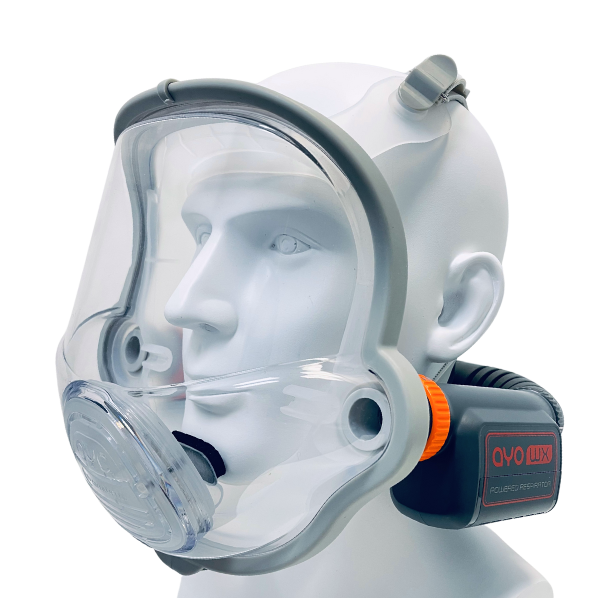
The AYO WX FFM-LF is loose-fitting. The AYO WX FFM-LF P-Boost is certified to EN 12941:2023 at class TH3, the highest class in that standard, as a loose-fitting full facepiece. Nothing seals against skin, so there is no fit test and no requirement to shave.

The AYO WX HFM and HFM-W are dual-fitting. They are certified to both the loose-fitting and the tight-fitting standards, and the wearer picks the mode:

  • Worn loose-fitting — no shaving, no fit test.
  • Worn tight-fitting — higher protection once it is fitted properly, and in that mode every tight-fitting rule above applies in full: clean shaven, fit tested, on record.

That is what dual-fitting buys you. One facepiece covers a bearded contractor on a two-day job and a clean-shaven operator on a high-exposure task, without running two fleets and two sets of paperwork.

Ask any supplier to be this specific, and to state the operating conditions with it. Ours are four:

  1. Loose-fitting protection is at least 40× a well-fitted P2 mask on a clean-shaven face — a ratio of nominal factors (TH3 = 500 under EN 12941, P2 = 12.5 under EN 140), not an assigned protection factor and not a figure an employer may claim.
  2. Match the class to your contaminant’s exposure limit. Selecting a level of protection against a measured exposure is the employer’s duty under AS/NZS 1715, and it stays there whichever facepiece you buy.
  3. Charge the battery fully before a long or hard shift.
  4. Do not run a blocked filter; replace more often in heavy dust.

Assigned protection factor (APF): why one device carries three different numbers

Framework Figure for TH3 What it is
EN 12941 (European device standard) 500 Nominal protection factor — a laboratory classification of the device
AS/NZS 1715 (Australian program standard) Set by the facepiece, not by the European class Required minimum protection factor — the reduction needed to bring the wearer below the exposure limit, assuming a clean-shaven, fit-tested and trained wearer. The device-class figures are in Table 4.6, §4.2.7
UK HSE APF 40 Assigned protection factor — what a UK employer may claim in a risk assessment

The number that governs your control decision comes from your own jurisdiction’s program standard. In Australia that is AS/NZS 1715, and it works from a required minimum protection factor — the measured airborne concentration divided by the exposure limit. That ratio is what decides which class of device a task needs.

Two things follow. The European 500 is a device classification, not a licence to work to 500. And the Australian mapping from a required factor to a device class is keyed to the facepiece, not to the European class — and it assumes a clean-shaven, fit-tested, trained wearer, which is the whole subject of this article.

We are deliberately not reproducing the device-class figures here. They are widely misquoted online, the most common error being to mix an Australian required protection factor with a European nominal one. Take the mapping from AS/NZS 1715 Table 4.6 (§4.2.7) itself, or from a certified occupational hygienist who has your exposure data in front of them.

Positive pressure is a condition, not a guarantee. It depends on the blower delivering adequate flow. At high work rates, or on a depleted battery, that margin narrows — which is precisely why airflow checks and alarm response belong in your training, and why battery and filter maintenance are program duties rather than housekeeping.

This is not only a protection question — it is an administrative one. Future Form, a formwork and concrete construction company, moved to loose-fitting PAPRs partly because high contractor turnover meant repeated fit testing on every new starter. Greg Rogers, their WHSE Manager, reports the change saved more than eight hours a month in administrative time and testing costs (Future Form case study). For a business with churn, fit testing is a recurring onboarding cost, not a one-off.

None of this removes your other obligations. Training, maintenance, records and health monitoring apply regardless of facepiece type. But if fit-test failures are driving your program’s cost and downtime, facepiece type is the variable worth examining. The facial hair question is more complicated than “shave or don’t”, and we have covered when a worker needs to shave and when they do not in detail.

The silica rules changed in September 2024

Since 1 September 2024, stronger regulation of crystalline silica substances has applied across all industries under the model WHS Regulations — not just engineered stone.

The workplace exposure standard for respirable crystalline silica is 0.05 mg/m³ averaged over eight hours, or an adjusted figure for extended shifts such as 12-hour rosters.

Two record-keeping duties follow, and both are commonly missed:

  • Air monitoring records must be kept for 30 years, and results must be provided to workers.
  • In NSW, since 1 September 2024, air monitoring results that exceed the WES must be notified to SafeWork NSW within 14 days of receiving the report. Check the equivalent notification duty with your own regulator.

Health monitoring is required where there is a significant risk to a worker’s health from ongoing RCS exposure — and critically, workers who rely on respiratory protective equipment as a control must be included in the health monitoring program. Issuing a PAPR does not take a worker out of scope. In many cases it puts them in scope.

The welding fume limit fell 80% — and that triggers your training duty

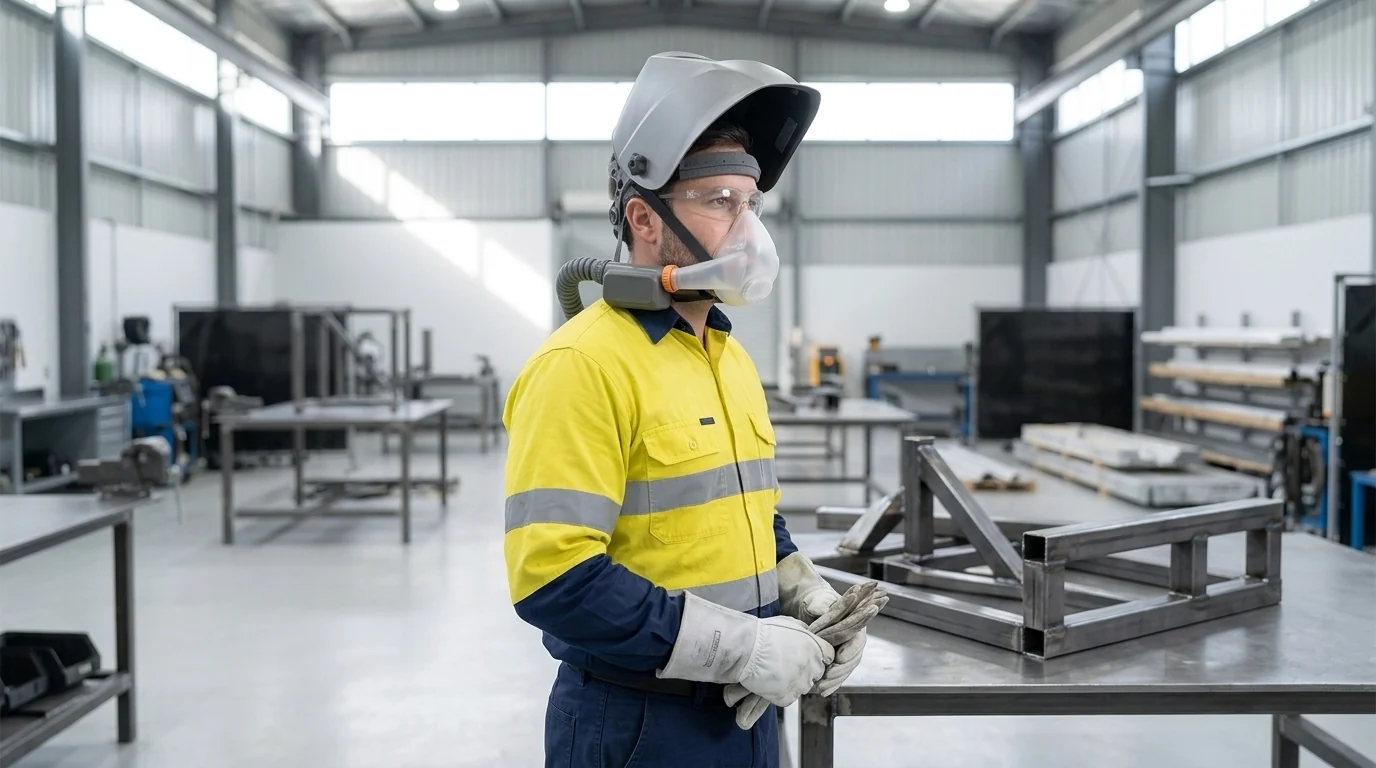
Illustration of a fabricator in a bright steel workshop with his welding helmet flipped up and clear safety glasses on, wearing a half-facepiece powered air purifying respirator whose breathing duct runs behind his neck
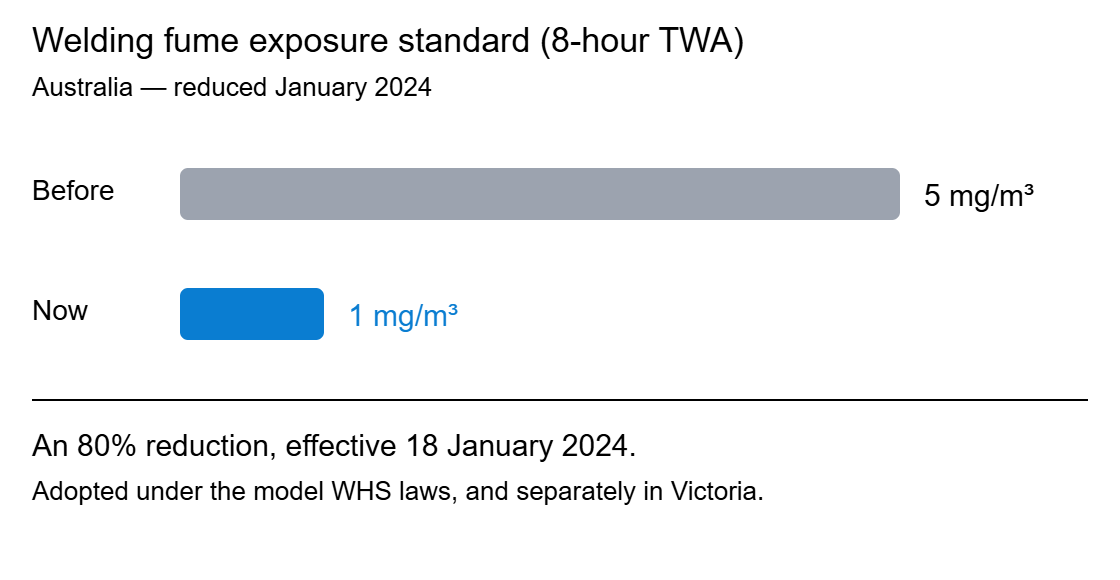
Australian workplace exposure standard for welding fume fell from 5 mg per cubic metre to 1 mg per cubic metre in January 2024, an 80 percent reduction

The standard fell from an eight-hour time weighted average of 5 mg/m³ to 1 mg/m³ for welding fumes not otherwise classified, following a decision by WHS ministers. The limit applies not only to welders but to other workers near them.

This one does apply in Victoria. WorkSafe Victoria confirms the same 1 mg/m³ standard took effect there on 18 January 2024 — a state can sit outside the model WHS framework and still adopt the same exposure standards.

Weld Australia’s recommended control hierarchy puts local exhaust ventilation first — hooded or on-gun extraction at the source. Where welders work in or near the plume, it names powered air-purifying respirators and externally air-fed helmets as the personal protection of choice.

If you moved welders onto PAPRs after the standard changed, that is a new make and model for every one of them — which triggers the training duty and, for tight-fitting facepieces, a fresh fit test.

The welding-specific system in our range is the AYO™ WX HFM-W P-Boost, designed to sit under an existing welding helmet rather than replace it.

How do you check a PAPR is actually certified for Australia?

The CE conformity mark, which indicates conformity with European Union requirements and is not a substitute for Australian AS/NZS 1716 certification

CE marking demonstrates conformity with EU requirements. It is not Australian certification.

CE marking is not Australian certification. They are separate schemes, with separate bodies, separate certificate numbers and separate expiry dates. A respirator can legitimately carry a CE mark and still not hold AS/NZS 1716 certification.

Ask any supplier for these five things. A compliant supplier will have them ready.

  1. The certificate number, not a logo on a brochure.
  2. The certification body, and its accreditation. In Australia, look for JAS-ANZ accreditation and operation to ISO/IEC 17065.
  3. The expiry date. Certificates lapse.
  4. The model and part numbers listed on the certificate — and check that the item you are quoting matches one of them, size included.
  5. A public verification route, so you are not relying on a PDF the supplier sent you.

For our own equipment, those answers are: AS/NZS 1716:2012 certificate PC10112, issued by CMI Certification Pty Ltd (JAS-ANZ accreditation No. Z4450210AK, operating to ISO/IEC 17065), certified 2 December 2024 and valid to 1 December 2029, verifiable at register.cmicert.com.au. The AYO™ WX full-face systems additionally meet AS/NZS 1337.1:2010 Medium Impact for eye protection.

Three AYO™ WX systems separately hold EN 12941:2023 TH3 P EU Type-Examination certificates (CCQS, Notified Body 2834) — downloadable from our certificate library, with part numbers that match the configurations listed in the AYO™ WX around-neck PAPR range. The dual-fitting facepieces are certified to EN 12942:2023 at TM3 as well, the tight-fitting equivalent, which is what lets them be worn either way.

The records a regulator will ask for

The regulations and the silica record-keeping duties above account for most of these. The rest are what we have seen inspectors actually ask for. Again, our checklist — not a statutory list:

  • The name of the program administrator
  • Hazard assessment and the RPE selection rationale for each task
  • Training records, per worker, with dates and content covered
  • Fit test records for tight-fitting equipment, with method, result and date
  • Issue records showing who holds which unit
  • Maintenance, cleaning, filter change and battery service logs
  • Air monitoring results — retained 30 years for RCS — and evidence they were provided to workers
  • Health monitoring records for workers relying on RPE as a control
  • Program review dates and what changed as a result

Most sites have the equipment and half the paperwork. The half that is missing is usually training records and maintenance logs.

Frequently asked questions

What should a fit test record actually contain?

There is no publicly published statutory template for this. Based on what we see requested in practice, record at minimum: the worker’s name, the date, the make, model and size tested, the test method used (qualitative or quantitative), the result, and who conducted it. Keep it retrievable per worker, because that is how it will be asked for. A test with no record is, for compliance purposes, a test that did not happen.

Who can conduct fit testing?

Our reading of AS/NZS 1715:2009 is that it expects a competent person. There is no single national licence, so competence is something you have to be able to demonstrate — through training records for the tester, the method used, and equipment calibration where quantitative testing is involved. Ask any external provider for those three things before booking.

Where to start

If you are auditing an existing program, start with the two documents most often missing: per-worker training records, and the maintenance log. Equipment is usually the part that has been done properly.

Specifying new equipment? Get the certificate number and the model list before you compare prices — and check whether a loose-fitting or dual-fitting facepiece removes a fit-testing problem you have been managing for years. Our view on why the industry over-indexes on the fit test is set out in is fit testing for respirators a flawed practice?

Aimwell manufactures the AYO™ WX PAPR range. For the full certificate, the part number schedule, or our training materials for your induction pack, get in touch — and if you are in NSW and eligible for the SafeWork rebate, we have configured a $1,000 PAPR bundle to match it.

About the author

Eric Fu is Managing Director of Aimwell Pty Ltd (ABN 68 652 924 957), an Australian respiratory protection manufacturer headquartered in Sydney. Aimwell designs the AYO™ WX powered air-purifying respirator range in Sydney and manufactures it in its own ISO 9001-certified facility in China.

I wrote this because the certification-versus-compliance distinction is the question we field most often from safety managers, and the answer is rarely stated plainly anywhere — including, too often, by suppliers.

This article describes regulatory obligations in general terms and is not legal advice. Requirements vary between states and territories. Confirm your duties with your WHS regulator. Figures and regulatory positions checked 7 August 2026.

PAPR Types: Four Ways to Wear a Powered Respirator

PAPR Types: Four Ways to Wear a Powered Respirator

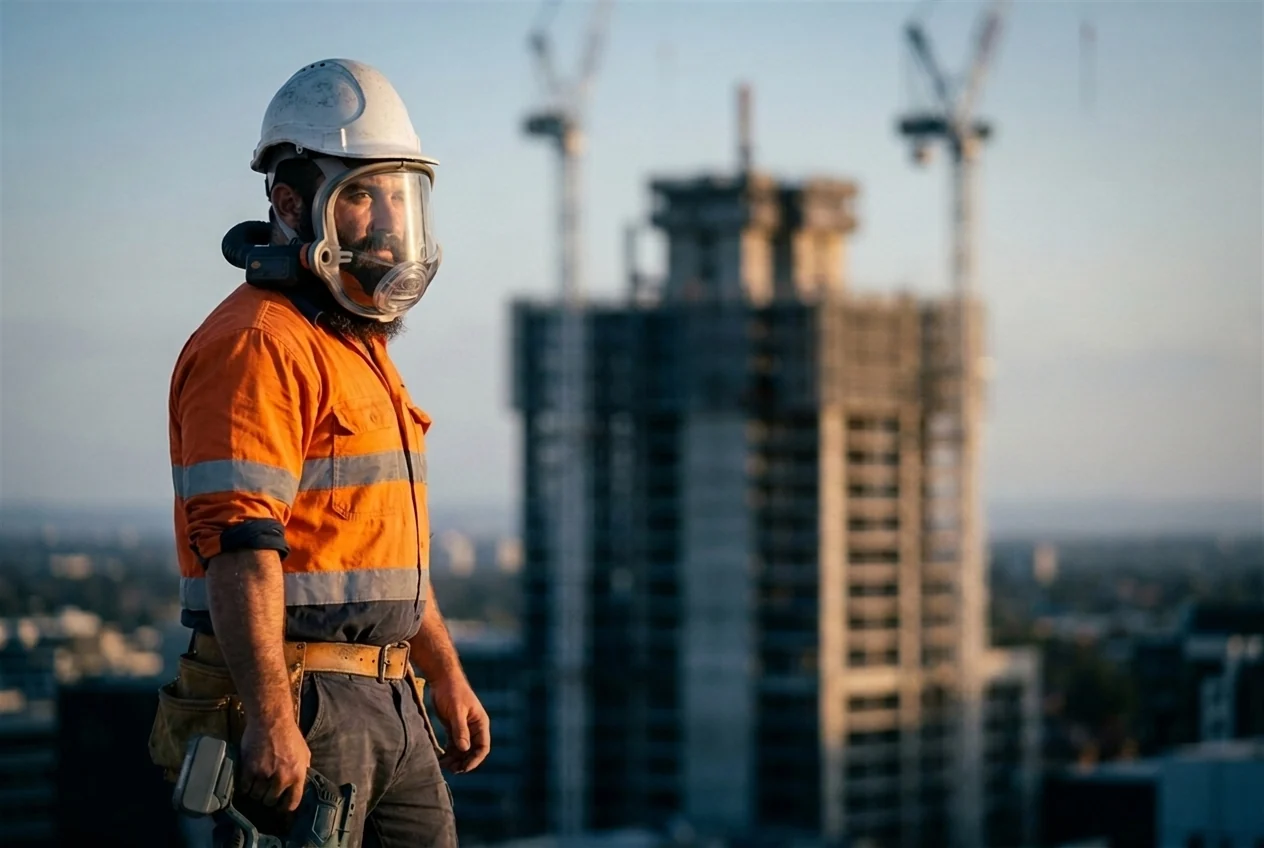
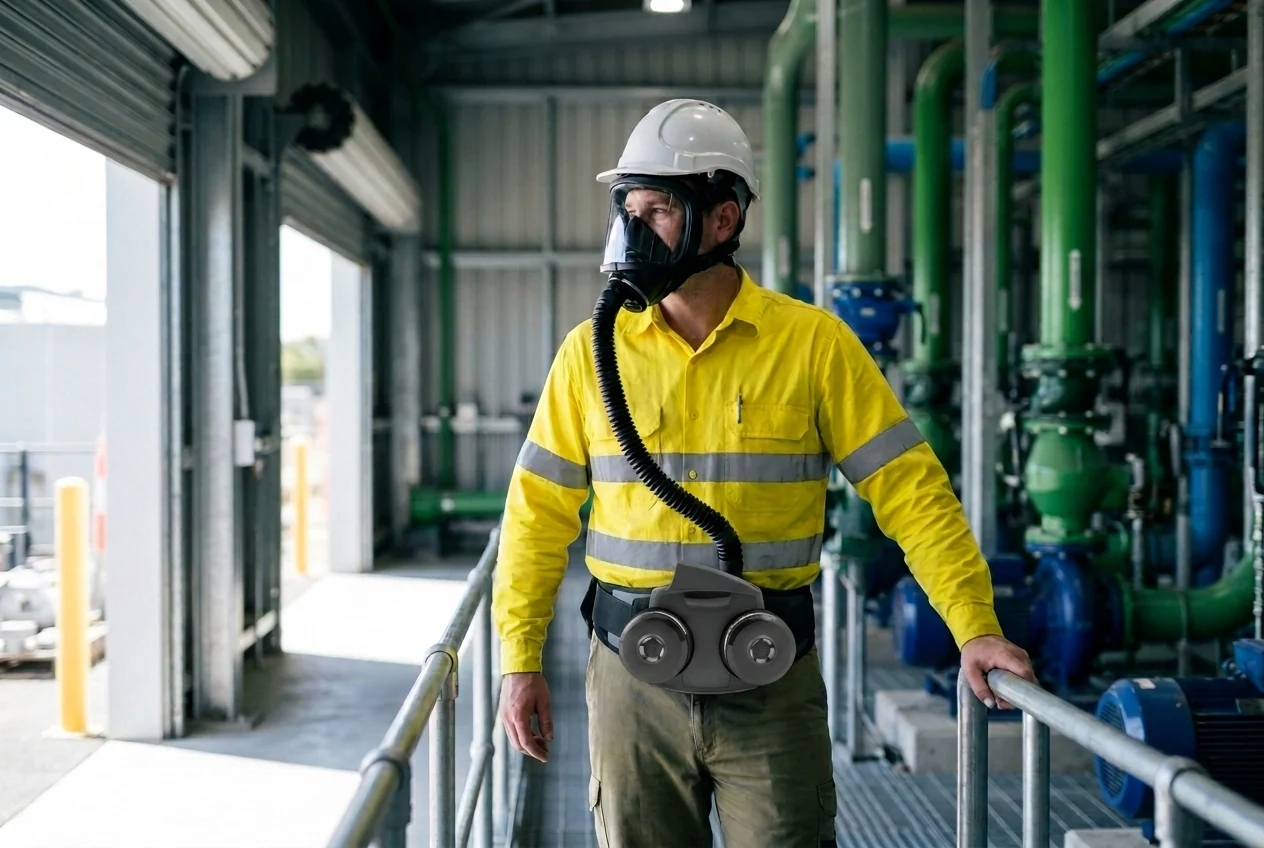
Illustration of a construction worker in hi-vis on a high-rise deck wearing an around-the-neck loose-fitting full-face powered air purifying respirator, with nothing crossing his chest

Where the blower sits on a powered air-purifying respirator decides how well you can do the work while wearing it — more than any number on the data sheet. Four layouts — the four main types of PAPR — dominate the market. Each imposes a cost the specification does not list — weight on the face, weight on the head, a hose that snags, or a helmet the job never asked for.

Protection class is the easy part of a purchase decision. A respirator that fights the work comes off during the work.

Key Takeaways

  • On-facepiece and in-helmet designs put the mass on the head, which fights downward work. Hose-and-belt designs tether the wearer, cross the field of view and are slow to don and doff. All four are difficult in confined spaces.
  • An around-the-neck layout keeps the profile low, allows fast don and doff, and runs either a half or a full facepiece. A hard hat becomes optional rather than compulsory, and confined spaces stop being a problem.
  • Aimwell Breath-responsive flow control lets the whole air source sit on the neck: a 437 g power unit and a 126 g filter, no belt and no hose. 3M’s published figure for a Versaflo TR-300+ with battery, belt and filter is 1,135 g. Less than half the weight, on both makers’ own figures — and that is what removes the hose and belt.
  • The same platform gives up to 220 L/min peak flow in P-Boost, and 8 to 16 hours on a user-replaceable battery.
  • A dual-fitting facepiece is certified to both the loose-fitting and the tight-fitting standard: no need to shave and no fit testing required as loose-fitting, higher protection when fitted tight.
  • AS/NZS 1715 and 1716 will be superseded by a suite of AS/NZS ISO standards by 1 January 2030. Both sets are valid in parallel until then.

The Ground Is Shifting Under the Whole Category

Two changes are running at once.

The first is regulatory. Australia and New Zealand are the first countries to adopt the ISO respiratory protection suite, a transition Standards Australia is running as a flagship project. Standards New Zealand states that by 1 January 2030 the two long-standing national standards will be superseded by more than thirty AS/NZS ISO standards, already adopted in parallel. What changes is what gets measured: the ISO framework describes performance by what the wearer needs — work rate and work of breathing — not by how the device was built.

The second is the trend. Employers are moving off negative-pressure respirators onto powered ones, and the market is growing in the order of 7 to 8 per cent a year to 2030. The demand is specific: low-profile, loose-fitting units that do not get in the way, at a price that lets a site fit out the whole crew rather than a few.

Both changes reward the same thing — a device judged by how it performs for a person doing work. That person notices the layout first.

Types of PAPR: Four Layouts, Four Different Costs

Layout Where the mass sits The cost to the wearer
On-facepiece — blower in the mask On the face Compact, but heavy on the face; affects downward vision and work; difficult in confined spaces; difficult to implement on a half facepiece
In-helmet — blower in a helmet On top of the head Head protection included by design, but top-heavy for downward work; difficult in confined spaces; loose-fitting only; not feasible on a half facepiece; the helmet is compulsory even when the job does not need one
Hose and belt, with a facepiece On the waist, hose to the mask The hose attaches to the mask and affects work and vision; limits mobility; difficult in confined spaces; troublesome to don and doff
Hose and belt, with a hood or helmet On the waist, hose to the head top Head and eye protection included, but the same tethering, plus loose-fitting only, not feasible on a half facepiece, and a compulsory hood or helmet

The same complaints repeat down that column: mass in the wrong place, a tether, a head covering the wearer did not choose, and — in every single row — trouble in confined spaces. None of them appear in a protection class.

They appear on site. A formwork worker looking down at a deck fights a top-heavy helmet all day. A fitter entering a vessel plans where the hose runs before they plan the task. A welder lifting a visor twenty times a shift judges the respirator on don-and-doff time, not just inward leakage.

Illustration of a generic waist-mounted powered respirator with a breathing hose running across the chest to a full facepiece, worn by a maintenance fitter in a plant room

Why Does an Around-the-Neck Layout Remove Those Costs?

Because it moves the mass to one place on the body that is not doing the work.

An around-the-neck unit sits low on the face, so downward vision stays clear. Mobility is unaffected, because nothing crosses the chest or shoulders. Don and doff is a single movement. It runs a half facepiece or a full facepiece, which the in-helmet and hood layouts cannot offer. A hard hat can be added when the job calls for one and left off when it does not. In-helmet and hood systems bundle head protection in permanently, which is useful on some worksites and a nuisance in a tight roof space.

Our systems are designed for high exertion, substantial body movement and confined spaces — see what makes the AYO WX around-neck design work in practice.

What Breath-Responsive Flow Control Actually Changes

A conventional PAPR runs its blower at a constant flow, whether the wearer is breathing in, breathing out or standing still. A breath-responsive unit matches delivery to the breathing cycle instead.

The consequence is physical, and large. The air source on our system is a 437 g power unit and a 126 g filter, worn on the neck with no belt and no hose. 3M’s own published technical data sheet puts a Versaflo TR-300+ at approximately 1,135 g including its high-capacity battery, belt and filter, before the breathing tube.

That is not a comfort statistic. It is the whole chain. Less energy moved means a smaller battery, and less mass is what lets the blower sit on the neck instead of a belt — which is what removes the hose. It saves carbon in a gas filter as well, because carbon is consumed by airflow the wearer never inhaled: less waste and lower running cost over the life of the system.

On our own platform this sits on the certificate record rather than in the brochure. Every certified system in the AYO™ WX around-neck PAPR range is described as controlled by a breath-responsive flow control algorithm. The numbers that follow: no hose and no belt, up to 220 L/min peak flow in P-Boost, and 8 to 16 hours on particulate duty from a user-replaceable battery. The blower is rated for over ten years and runs under 65 dB in typical use.

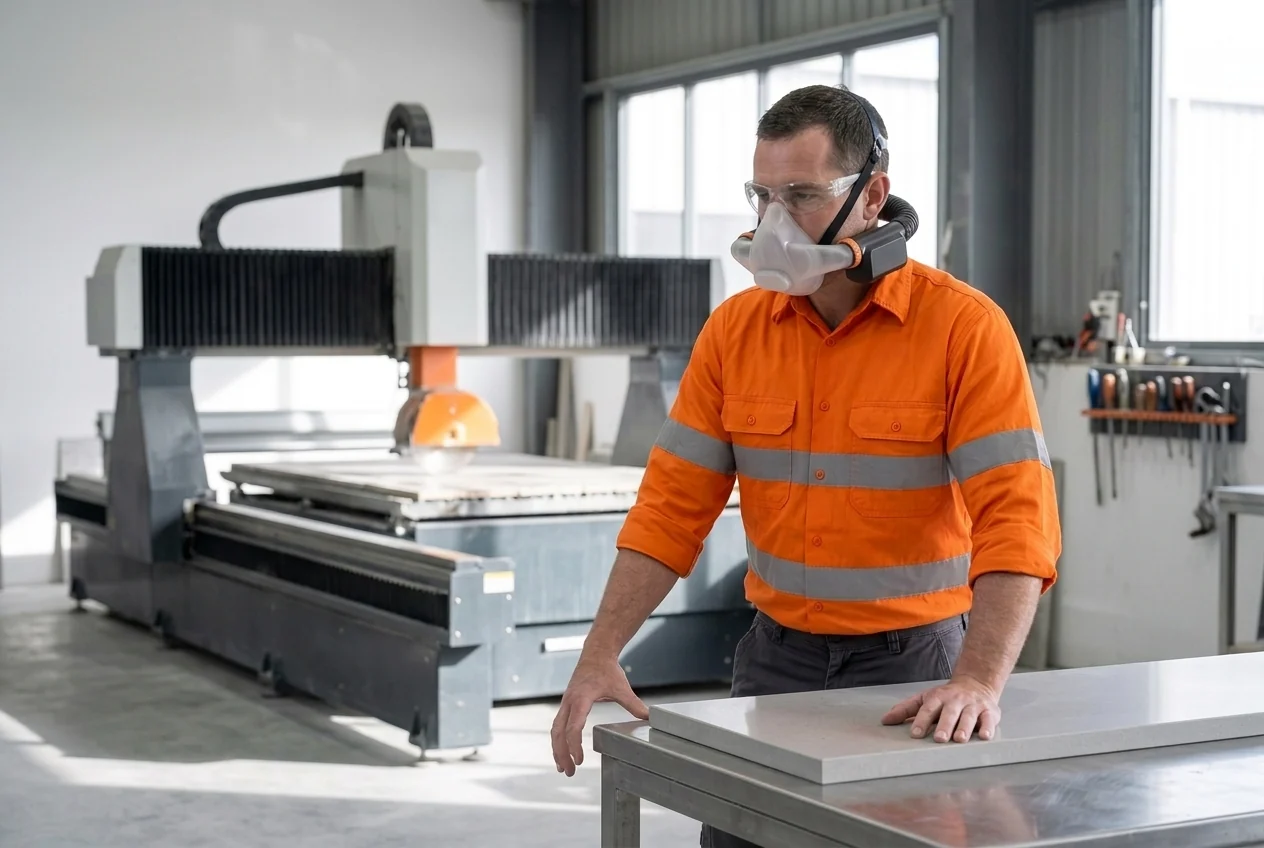
Illustration of a stone benchtop fabricator inspecting a finished cut in a clean, well-lit workshop while wearing an around-the-neck half-face powered air purifying respirator

Is Dual-Fitting Worth Specifying?

On a mixed site, yes.

A dual-fitting facepiece is certified to both the loose-fitting and the tight-fitting standard. Used loose-fitting it does not depend on a seal against skin, so there is no need to shave and no fit testing is required. Used tight-fitting and fitted properly, it achieves the increased protection the tight-fitting standard measures. One purchase therefore covers a clean-shaven fitter and a bearded one, and covers a site whose answer changes between jobs.

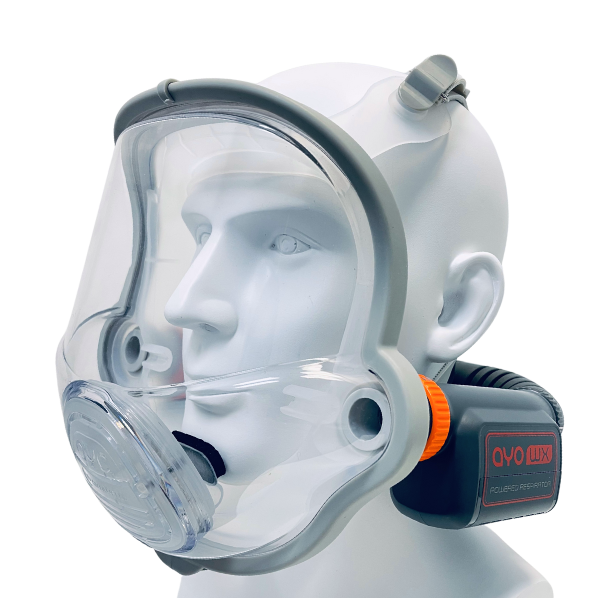
The AYO™ WX HFM Standard Half-Face Mask PAPR Systems and the welding and double-seal variants sit on that platform, certified to EN 12941:2023 as TH3 and EN 12942:2023 as TM3. In our own framing, TM3 represents four times the protection of TH3 — the two classes come from different test regimes, so the raw numbers are not comparable.

Two add-ons fit the same platform rather than needing a second system: a Face Seal Kit for workers with longer beards, and a Shower Kit for sites that run decontamination showers.

One thing to confirm before you specify: check that TH3 is adequate for the exposure limit of the contaminants in your application. That is a judgement for a certified occupational hygienist — the Australian Institute of Occupational Hygienists maintains the register.

Replacing a hose-and-belt fleet, or specifying a PAPR for a site where the work is downward, confined or bearded?

See the AYO™ WX FFM-LF Loose-Fitting Full-Face Mask

Happy to work through the selection with your hygienist, and to send the certificates and part number schedule before you compare prices.

About the Author

Eric Fu is Managing Director of Aimwell Pty Ltd (ABN 68 652 924 957). He has twenty-seven years in the respiratory device industry — CPAP, industrial powered respirators and breathing measurement devices — and holds multiple international patents. Aimwell designs the AYO™ WX range in Sydney.

Case Study – Running Cost Comparison Between a NAPR and an AYO WX HFM P-Boost

Case Study – Running Cost Comparison Between a NAPR and an AYO WX HFM P-Boost

From a performance standpoint, an elastomeric non-powered air purifying respirator (NAPR) can achieve a better seal than a N95 disposable paper mask thus achieving better protection. In addition, its filter cartridge can be protected from breath and can be designed with a higher dust-loading capacity, therefore, can last longer.
Another important point of a NAPR is that it is reusable, more cost-saving in the long run, and more environmentally friendly. Thus, it is not surprising that NAPR’s market share is on the rise.

However, when it comes to powered air-purifying respirators (PAPRs), apart from being elastomeric, they offer better protection by design, as the pressure inside the breathing zone is positive, and they are also more comfortable to breathe.

Research shows that the NAPRs market size was over USD 9.5 billion in 2022, compared with USD 2.4 billion for PAPRs. Assuming an average NAPR is USD 50, and an average PAPR is USD 1000, which is roughly about right, this suggests a ratio of 79:1, meaning for 79 NAPR users, there is only one PAPR user. So there is more room for PAPRs to grow.

In fact, the industry trend is heading for more workers to move up from NAPRs toward PAPRs for better protection. For example, in Australia, the exposure limit for welding fumes is reduced from 5mg/m3 to 1mg/m3, and this almost certainly will demand the use of PAPRs in many welding sites. We explain what the lower limit means for monitoring and respirator selection in our guide to the welding fume exposure standard in Australia.

However, most PAPRs are much more expensive than NAPRs, and they are also bulky, heavy, and troublesome to use and maintain, and these are the key inhibitors of their adoption. Therefore, it is easy to comprehend that there are more users of NAPRs than PAPRs.

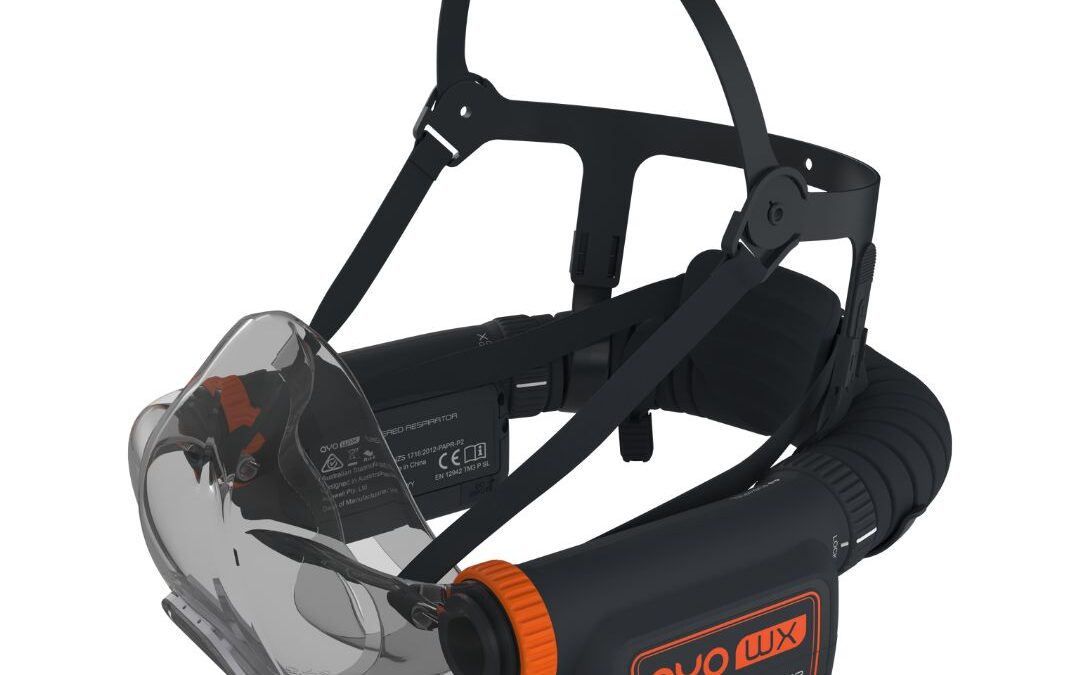
To allow widespread workers to be able to take advantage of the improved protection from PAPR technology, Aimwell designed and manufactures the AYO WX HFM P-Boost Dual-Fiting Half-Face Mask PAPR System and AYO WX FFM-LF Loose-Fitting Full-Face Mask PAPR System, and we believe it can not only significantly enhance respiratory protection, but can also cost less within 12 months of use compared with typical NAPRs when doing daily dusty work, such as stonework.

Here is our case study:

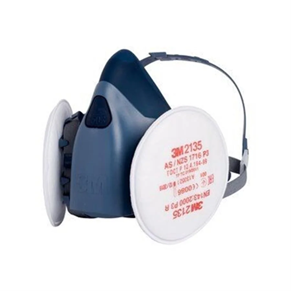
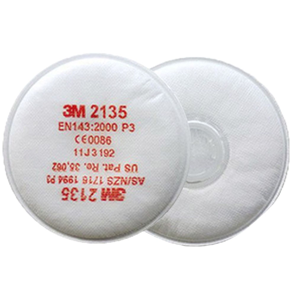
Target NAPR: 3M 6200 with 2135 P2/P3 particular filter.

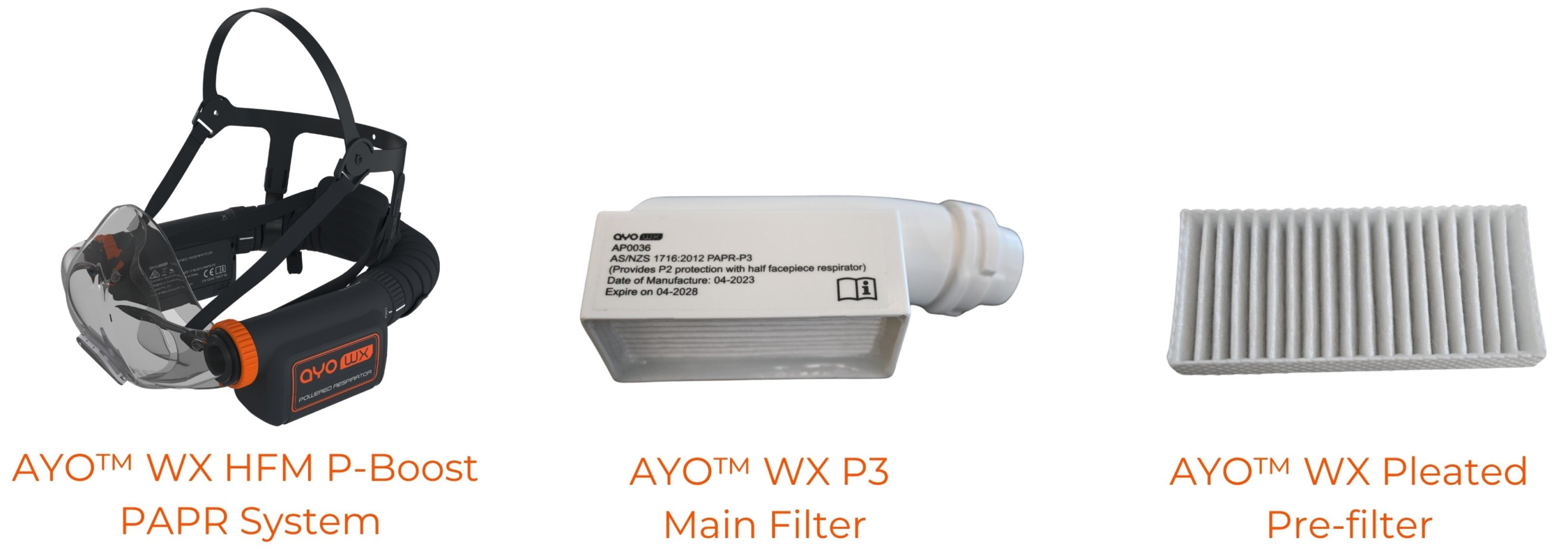
Comparing PAPR: AYO WX HFM P-Boost Dual-Fitting Half-Face Mask PAPR System with pleated pre-filter and PAPR P3 HEPA filter.

Target application: Stonework
Estimated Filter replacement:

  • 3M 2135 P2/P3 filter: every 5 days
  • AYO WX Pleated pre-filter: every 2 days.
  • AYO WX Main filter: every 20 days.

Result:

Product Initial Cost (RRP) (AUD) Fit Test Cost (AUD) Days to Replace 12 Months Filter Cost (AUD) 12 Months Total Cost (AUD)
3M 6200 Mask $45.00
3M 2135 P2/P3 Particulate filter (pair) $25.00 5 $1,175.00
3M 6200/2135 System $70.00 $100.00 $1,345.00
AYO™ WX P3 Main Filter $26.4 60 $79.30
AYO™ WX Pleated Pre-filter $3.10 2 $371.30
AYO™ WX HFM P-Boost $738.60 $1,189.20

Analysis:

  • At initial purchase, the 3M 6200/2135 system costs $70 versus $738.6 of AYO WX HFM P-Boost.
  • Due to the design of 3M 2135 particle filter, there is no pre-filter that can be replaced cheaply. As a result, every 5 working days, the whole pair of filters needs to be replaced.
  • On the contrary, AYO WX HFM P-Boost PAPR has a unique low-cost pleated pre-filter that can capture larger particles with reasonable dust-loading capacity and protect the HEPA filter. As a result, the HEPA filter can last longer, normally at least 60 days, while the pleated prefilter can be changed often, such as every 2 days at a very low cost.
  • At 12 months of use, the total cost of use for AYO WX HFM P-Boost PAPR is $1,189.2 versus $1,345.0 for the 3M 6200/2135 system.

Other Considerations

  • AYO WX HFM P-Boost has much higher protection than the 3M 6200/2135 system: at least 40 times better for a clean-shaven and well-fitted user.
  • The above cost comparison is based on the RRP for one AYO WX HFM P-Boost Half-face Mask PAPR System. For large organisations with higher order quantities, the unit price will be lower than the RRP, thus the ‘breakeven’ time will be shorter accordingly.
  • Being a PAPR, AYO WX HFM P-Boost PAPR is more comfortable to breathe, especially for long working hours.
  • Being a certified Dual-Fitting PAPR, AYO WX HFM P-Boost is compatible with facial hairs, allowing some leak while still achieving excellent (TH3) protection; no fit testing is needed.  Compared with a NAPR, the protection of 3M 6200/2135 is highly sensitive to facial leaks, and the users shall be clean-shaven and fit tested. Often, regular fit testing costs significant time and money for an organisation, adding to the actual cost.
  • With patented around-neck technology, AYO WX HFM P-Boost PAPR achieves a great wearability similar to common NAPRs. This is dramatically different from most common PAPRs, which are bulky and heavy, with poor mobility.

For daily work in highly dusty environments, AYO WX HFM P-Boost Half-Face Mask PAPR System can not only provide better and more reliable protection than a typical NAPR but also costs less after using for 1 year, in addition to being more comfortable to breathe, making AYO WX HFM P-Boost PAPR a perfect upgrade from common NAPRs for many industrial respiratory protection applications.

Aimwell™ at AIOH 2025

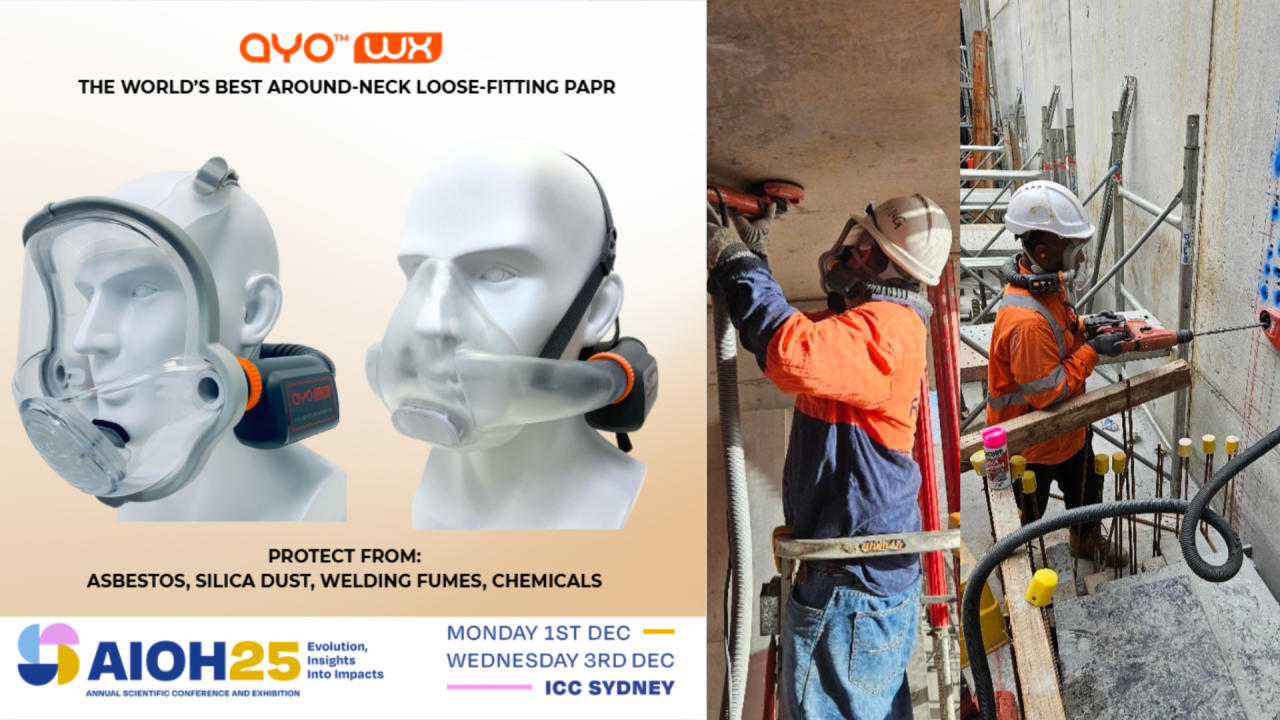
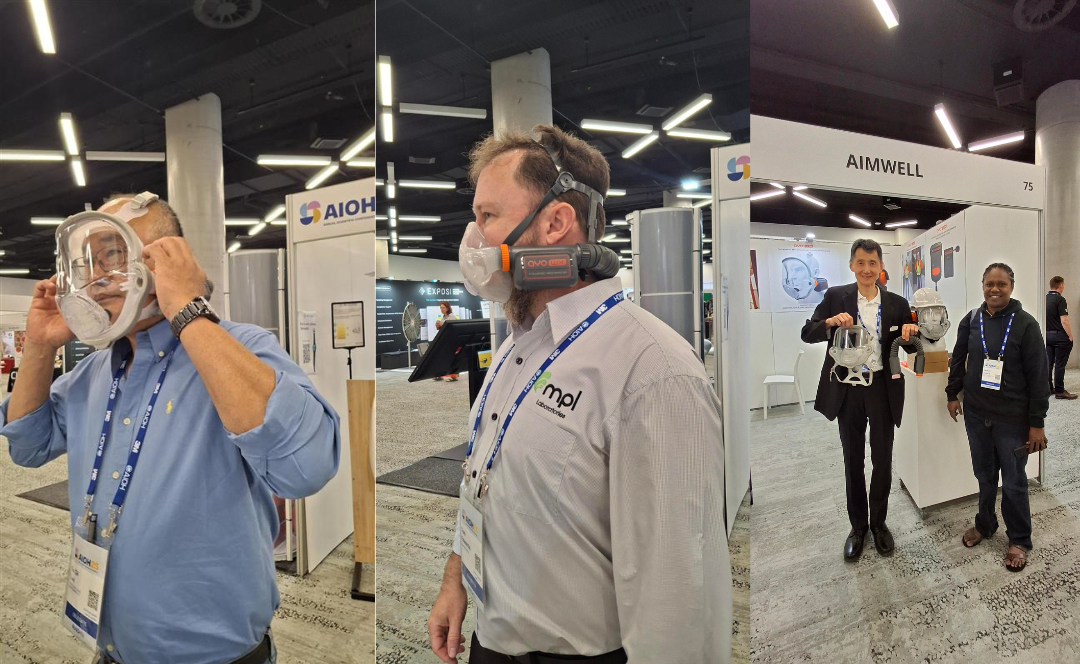
We were proud to exhibit at the Australian Institute of Occupational Hygienists (AIOH) Annual Conference 2025, one of the most important events in the occupational health and safety calendar.

Held from 1–3 December, AIOH 2025 brought together occupational hygienists, safety professionals, regulators, and industry leaders to explore emerging risks, new technologies, and future-focused approaches to worker health protection.

Thank you to everyone who stopped by and shared insights with our team.

Strong Conversations Across High-Risk Industries

Throughout AIOH 2025, the Aimwell™ booth attracted strong interest from professionals across mining, construction, manufacturing, and other high-risk sectors.

Many conversations focused on a shared challenge:

👉 how to deliver high-level respiratory protection without compromising comfort, mobility, or productivity in demanding environments.

It was encouraging to see growing industry demand for practical, worker-friendly respiratory solutions.

Spotlight on Aimwell™ Around-Neck PAPR Technology

One of the highlights of AIOH 2025 was the response to our World-Leading Around-Neck Powered Air-Purifying Respirator (PAPR) Series.

Attendees were particularly interested in:

  • The around-neck design, low profile and light weight, enabling greater freedom of movement and simplicity to use.
  • Unique loose-fitting solution without hose and belt, yet compatible with beards and facial hair, no need for fit testing.
  • Advanced AYO™ TALK-MIC wireless speaker system as an Add-on to our PAPRs.
  • Great value for money, designed for widespread use.

We’re proud to share a Major Milestone:

In addition to being fully certified to AS/NZS 1716: 2012 with PAPR P3 class, the AYO™ WX FFM-LF Loose-Fitting Full-Face Mask PAPR and AYO™ WX HFM Half-Face Mask PAPR have both successfully passed EN 12941:2023 type testing, achieving TH3 class.

This is great news for workers with beards, or for organisations that wish to avoid/reduce fit testing.

This certification reinforces our commitment to make our PAPRs practical and flexible to use without compromising protection and compliance.

Missed Us at AIOH 2025?

You can learn more about Aimwell™ Industrial Respiratory safety solutions here:

🔗 https://aimwellbreathing.com/industrial-respirator/

Thank you to everyone who connected with us at AIOH 2025.

We look forward to continuing to work alongside industry leaders to help protect workers’ lungs — today and into the future.

How Does Aimwell™ AYO™ WX HFM P-Boost Standard Half Face Mask PAPR System Compare with Other Half Face Mask PAPR Brands?

PAPR Type Brand/Model Key Comparison
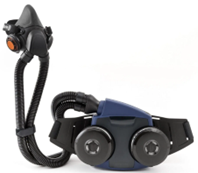
Face-mounted Tight-fitting

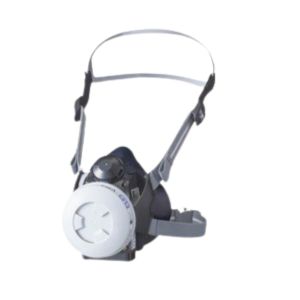
SHIGEMATSU

Sync11VP3

Protection level: AS/NZS 1716 PAPR P3
Peak flow:  only 138 L/min (Breath responsive)
Weight: 0.45 kg (particulate filter)
Battery Time: 11 hours
Cost: $1293

Shortcoming:

  •  Low flow – not suitable for heavy work.
  • One Size only: may not be suitable for very small or very large faces.
  • Tight-fitting only: must be clean-shaven and fit tested.
  • Not easy to clean – The blower unit is not easily removable, and the mask can not be soaked for cleaning.
  • Expensive
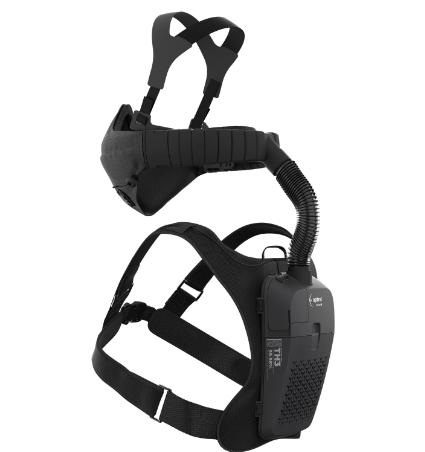
Belt-mounted Tight-fitting

Sundstrom SR700/SR900

Protection level: AS/NZS 1716 PAPR P3
Peak flow:  175 or 225 L/min
Weight: 1.24 kg (not including hoses)
Battery Time: 8 hours
Cost: $1899

Shortcoming:

  • Poor mobility – Bulky, heavy with long hose, troublesome to wear, not suitable in confined spaces.
  • Tight-fitting only: must be clean-shaven and fit tested.
  • Not easy to clean.
  • Expensive.

Back-mounted

Loose-fitting

Optrel Swiss Air System

Protection level: EN12941 TH3
Peak flow: only 130 L/min
Weight: 1.2 kg
Battery Time: 14 hours
Cost: $2122

Shortcoming:

  • P2 protection only.
  • Low flow – not suitable for heavy work.
  • Poor mobility and wearability – bulky, troublesome to wear at the back.
  • Not easy to clean.
  • Expensive.

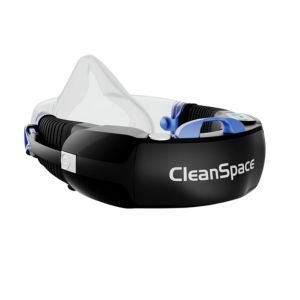
Around-neck

Tight-fitting

CleanSpace Works

Protection level: AS/NZS 1716 PAPR P3
Peak flow: 200 L/min (Breath responsive)
Weight: 0.54 kg
Battery Time: 8 hours
Cost: $990

Shortcoming:

  • The battery is not replaceable – when the battery is dead, the system dies.
  • Head movement restrictions due to the rigid and bulky neck module.
  • Uncomfortable at the neck when raising the head.
  • Tight-fitting only: must be clean-shaven and fit tested.
  • Expensive, given the product life is limited by battery life.

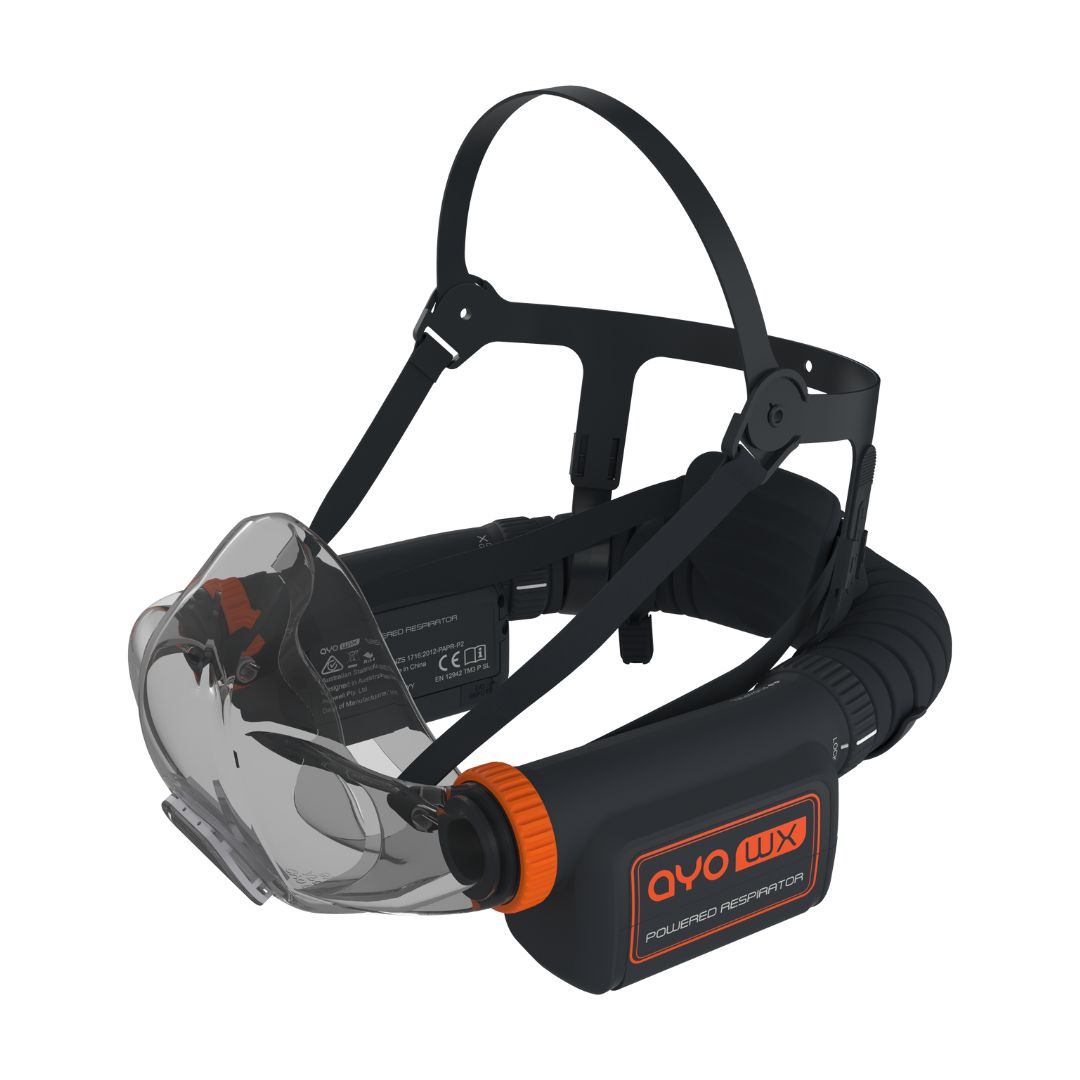
Around-neck

Tight-fitting and loose-fitting configurable

Aimwell™ AYO™ WX HFM P-Boost Standard Half-Face Mask PAPR System

Protection level: AS/NZS 1716 PAPR P3, EN 12942:2023 TM3, EN 12941:2023 TH3.
Peak flow: Up to 220 L/min (Breath responsive)
Weight: 0.70kg
Battery Time: 16 hours
Battery replaceable
Cost: $739

Best overall performance among all:

  • Best-in-class protection PAPR P3, TM3, TH3.
  • World’s only Dual-Fitting half-face mask PAPR – unprecedented usability and flexibility.
  • Great mobility – good head movement and comfort, no nuisance long hose and belt.
  • Very long battery hours, battery replaceable.
  • Very easy to clean and maintain.
  • Face Seal option for beard-covering.
  • The most value-for-money Half-face Mask PAPR in the world.
In summary, the AYO™ WX HFM P-Boost Standard Half-Face Mask PAPR System is on par or better than most other PAPR brands regarding peak flow performance, while it stands out in mobility, unique dual-fitting, ease of use, and value-for-money.

Buy AYO™ WX HFM P-Boost Standard Half-Face Mask PAPR System – the best all-rounder Half-Face Mask PAPR System in the world.

0
0
Your Cart
Your cart is emptyReturn to Shop