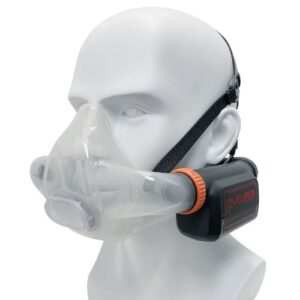
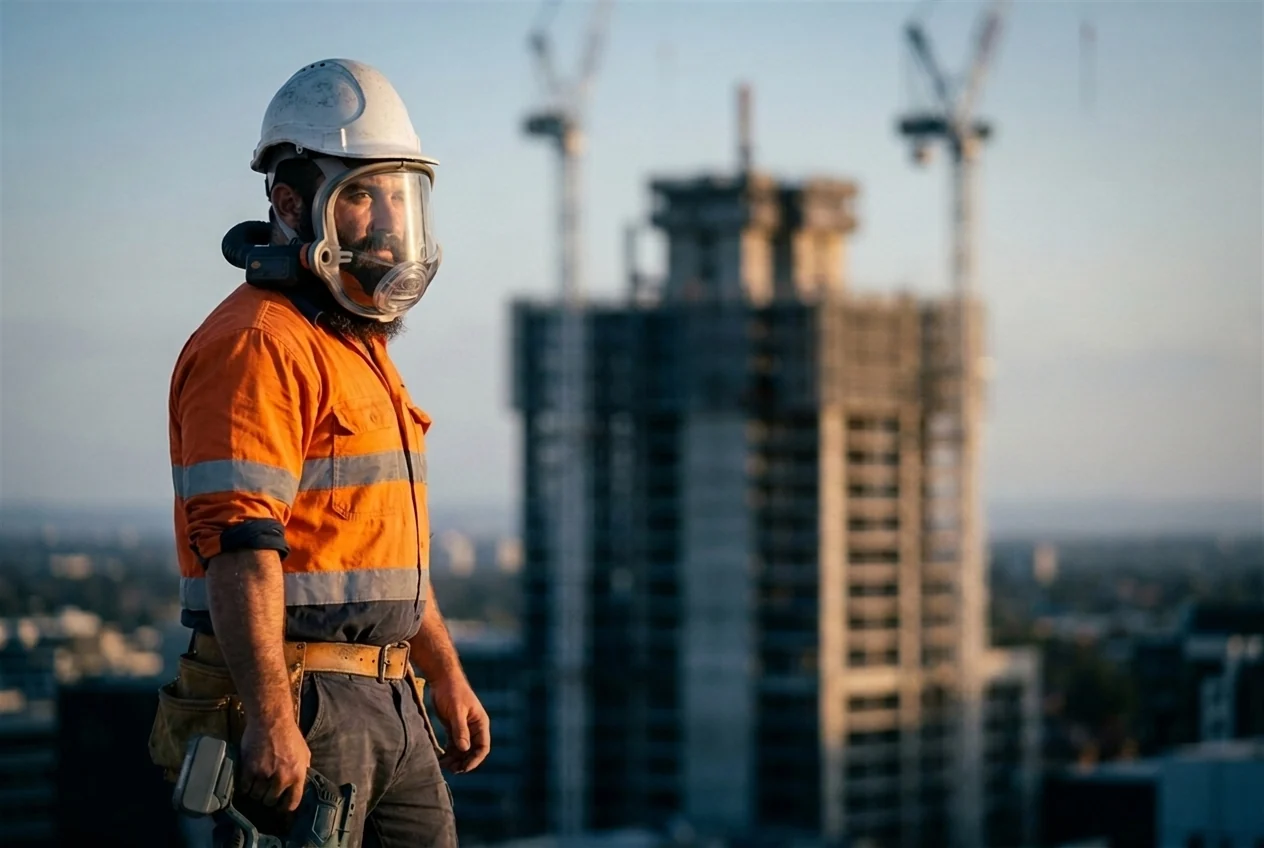
Where the blower sits on a powered air-purifying respirator decides how well you can do the work while wearing it — more than any number on the data sheet. Four layouts dominate the market. Each imposes a cost the specification does not list — weight on the face, weight on the head, a hose that snags, or a helmet the job never asked for.
Protection class is the easy part of a purchase decision. A respirator that fights the work comes off during the work.
Key Takeaways
- On-facepiece and in-helmet designs put the mass on the head, which fights downward work. Hose-and-belt designs tether the wearer, cross the field of view and are slow to don and doff. All four are difficult in confined spaces.
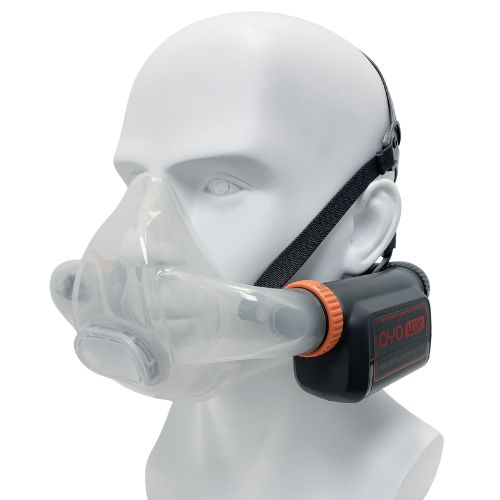
- An around-the-neck layout keeps the profile low, allows fast don and doff, and runs either a half or a full facepiece. A hard hat becomes optional rather than compulsory, and confined spaces stop being a problem.
- Aimwell Breath-responsive flow control lets the whole air source sit on the neck: a 437 g power unit and a 126 g filter, no belt and no hose. 3M’s published figure for a Versaflo TR-300+ with battery, belt and filter is 1,135 g. Less than half the weight, on both makers’ own figures — and that is what removes the hose and belt.
- The same platform gives up to 220 L/min peak flow in P-Boost, and 8 to 16 hours on a user-replaceable battery.
- A dual-fitting facepiece is certified to both the loose-fitting and the tight-fitting standard: no need to shave and no fit testing required as loose-fitting, higher protection when fitted tight.
- AS/NZS 1715 and 1716 will be superseded by a suite of AS/NZS ISO standards by 1 January 2030. Both sets are valid in parallel until then.
The Ground Is Shifting Under the Whole Category
Two changes are running at once.
The first is regulatory. Australia and New Zealand are the first countries to adopt the ISO respiratory protection suite, a transition Standards Australia is running as a flagship project. Standards New Zealand states that by 1 January 2030 the two long-standing national standards will be superseded by more than thirty AS/NZS ISO standards, already adopted in parallel. What changes is what gets measured: the ISO framework describes performance by what the wearer needs — work rate and work of breathing — not by how the device was built.
The second is the trend. Employers are moving off negative-pressure respirators onto powered ones, and the market is growing in the order of 7 to 8 per cent a year to 2030. The demand is specific: low-profile, loose-fitting units that do not get in the way, at a price that lets a site fit out the whole crew rather than a few.
Both changes reward the same thing — a device judged by how it performs for a person doing work. That person notices the layout first.
Four Layouts, Four Different Costs
| Layout | Where the mass sits | The cost to the wearer |
|---|---|---|
| On-facepiece — blower in the mask | On the face | Compact, but heavy on the face; affects downward vision and work; difficult in confined spaces; difficult to implement on a half facepiece |
| In-helmet — blower in a helmet | On top of the head | Head protection included by design, but top-heavy for downward work; difficult in confined spaces; loose-fitting only; not feasible on a half facepiece; the helmet is compulsory even when the job does not need one |
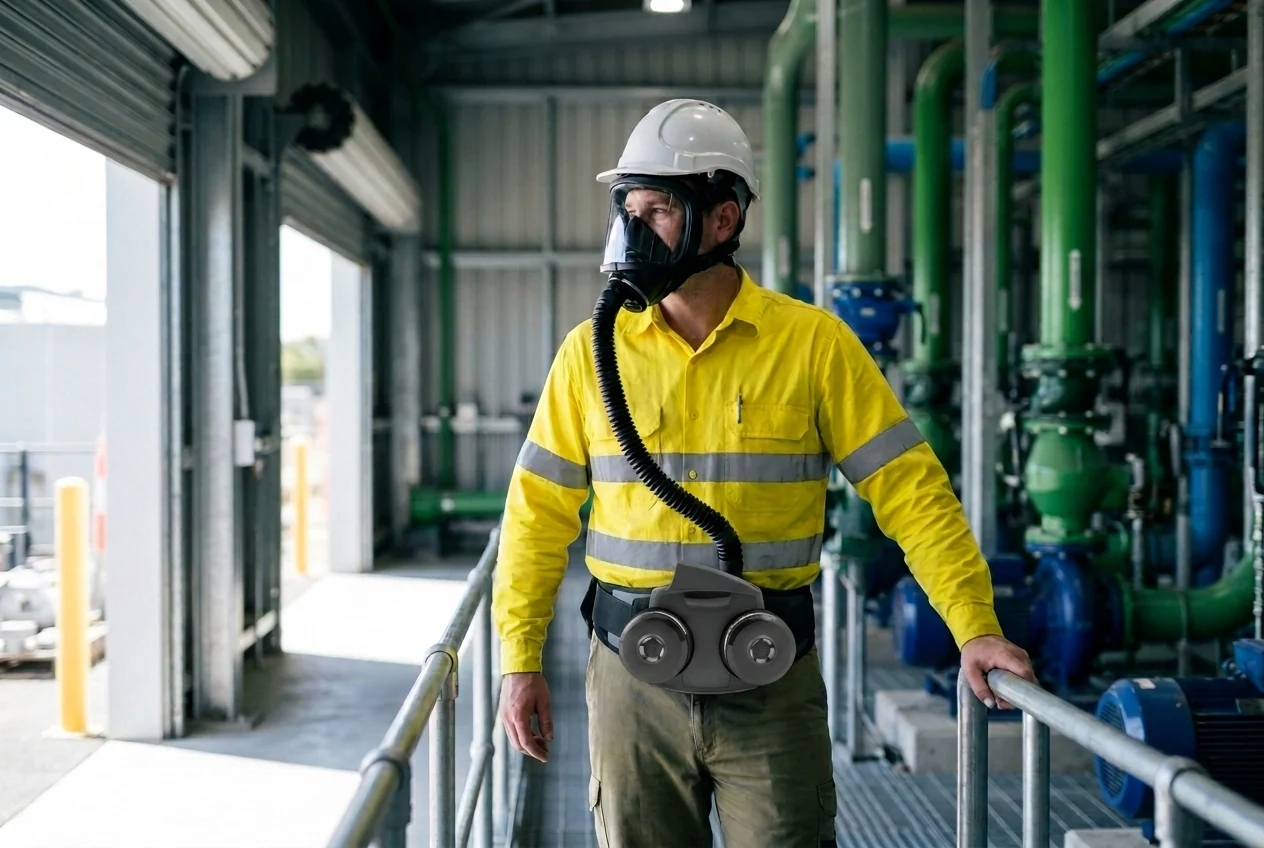
| Hose and belt, with a facepiece | On the waist, hose to the mask | The hose attaches to the mask and affects work and vision; limits mobility; difficult in confined spaces; troublesome to don and doff |
| Hose and belt, with a hood or helmet | On the waist, hose to the head top | Head and eye protection included, but the same tethering, plus loose-fitting only, not feasible on a half facepiece, and a compulsory hood or helmet |
The same complaints repeat down that column: mass in the wrong place, a tether, a head covering the wearer did not choose, and — in every single row — trouble in confined spaces. None of them appear in a protection class.
They appear on site. A formwork worker looking down at a deck fights a top-heavy helmet all day. A fitter entering a vessel plans where the hose runs before they plan the task. A welder lifting a visor twenty times a shift judges the respirator on don-and-doff time, not just inward leakage.
Why Does an Around-the-Neck Layout Remove Those Costs?
Because it moves the mass to one place on the body that is not doing the work.
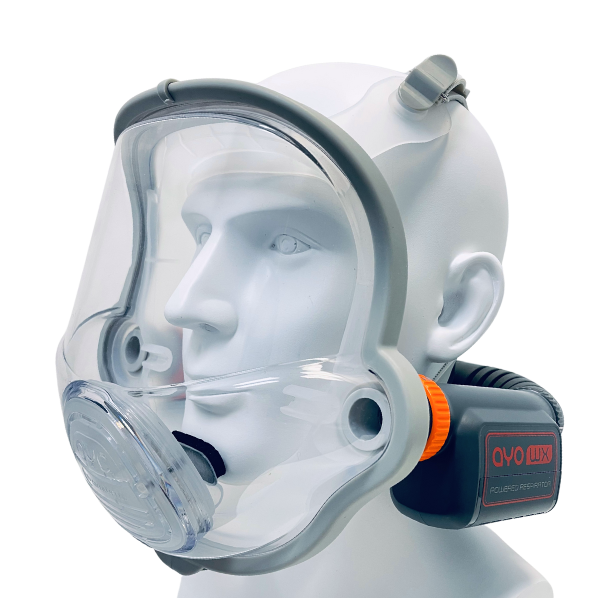
An around-the-neck unit sits low on the face, so downward vision stays clear. Mobility is unaffected, because nothing crosses the chest or shoulders. Don and doff is a single movement. It runs a half facepiece or a full facepiece, which the in-helmet and hood layouts cannot offer. A hard hat can be added when the job calls for one and left off when it does not. In-helmet and hood systems bundle head protection in permanently, which is useful on some worksites and a nuisance in a tight roof space.
Our systems are designed for high exertion, substantial body movement and confined spaces.
What Breath-Responsive Flow Control Actually Changes
A conventional PAPR runs its blower at a constant flow, whether the wearer is breathing in, breathing out or standing still. A breath-responsive unit matches delivery to the breathing cycle instead.
The consequence is physical, and large. The air source on our system is a 437 g power unit and a 126 g filter, worn on the neck with no belt and no hose. 3M’s own published technical data sheet puts a Versaflo TR-300+ at approximately 1,135 g including its high-capacity battery, belt and filter, before the breathing tube.
That is not a comfort statistic. It is the whole chain. Less energy moved means a smaller battery, and less mass is what lets the blower sit on the neck instead of a belt — which is what removes the hose. It saves carbon in a gas filter as well, because carbon is consumed by airflow the wearer never inhaled: less waste and lower running cost over the life of the system.
On our own platform this sits on the certificate record rather than in the brochure. Every certified system in the AYO™ WX around-neck PAPR range is described as controlled by a breath-responsive flow control algorithm. The numbers that follow: no hose and no belt, up to 220 L/min peak flow in P-Boost, and 8 to 16 hours on particulate duty from a user-replaceable battery. The blower is rated for over ten years and runs under 65 dB in typical use.
Is Dual-Fitting Worth Specifying?
On a mixed site, yes.
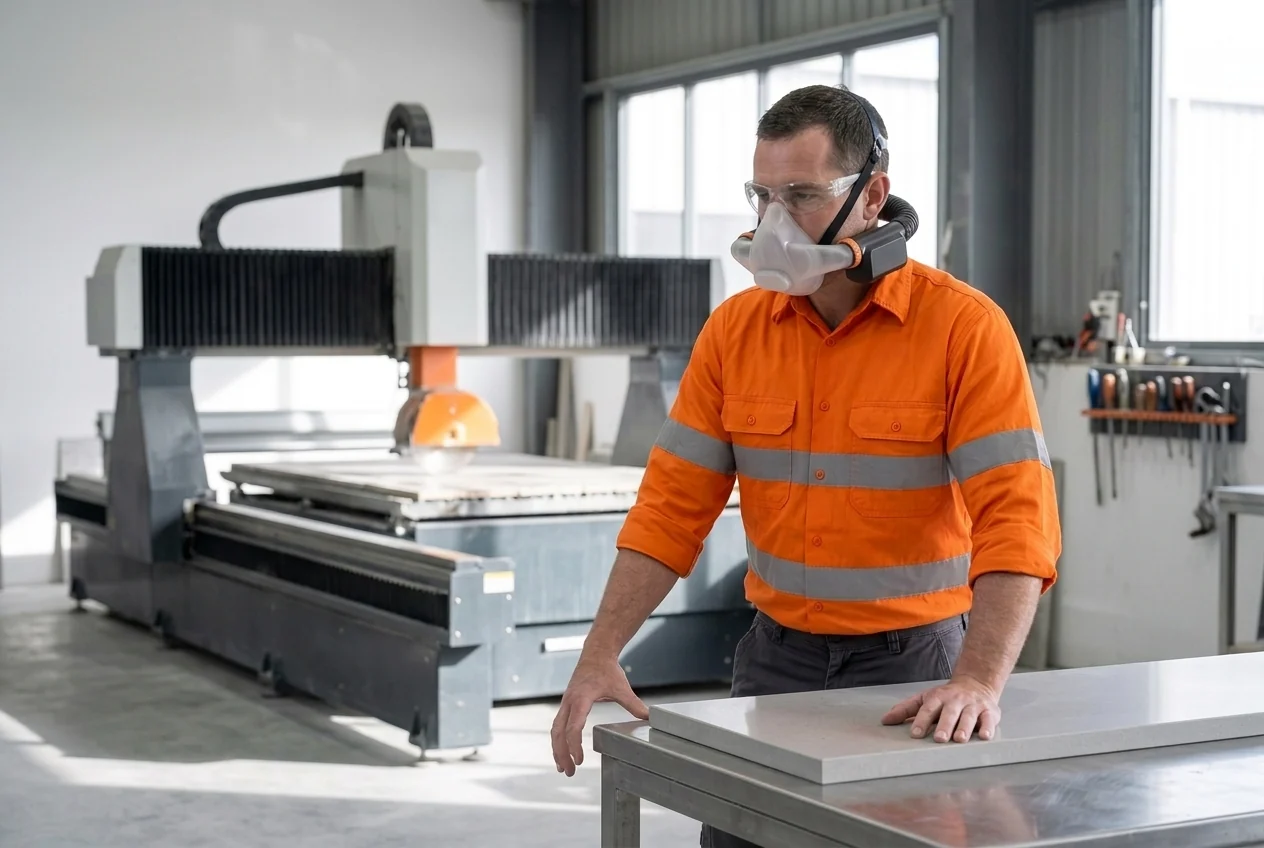
A dual-fitting facepiece is certified to both the loose-fitting and the tight-fitting standard. Used loose-fitting it does not depend on a seal against skin, so there is no need to shave and no fit testing is required. Used tight-fitting and fitted properly, it achieves the increased protection the tight-fitting standard measures. One purchase therefore covers a clean-shaven fitter and a bearded one, and covers a site whose answer changes between jobs.
The AYO™ WX HFM Standard Half-Face Mask PAPR Systems and the welding and double-seal variants sit on that platform, certified to EN 12941:2023 as TH3 and EN 12942:2023 as TM3. In our own framing, TM3 represents four times the protection of TH3 — the two classes come from different test regimes, so the raw numbers are not comparable.
Two add-ons fit the same platform rather than needing a second system: a Face Seal Kit for workers with longer beards, and a Shower Kit for sites that run decontamination showers.
One thing to confirm before you specify: check that TH3 is adequate for the exposure limit of the contaminants in your application. That is a judgement for a certified occupational hygienist — the Australian Institute of Occupational Hygienists maintains the register.
Replacing a hose-and-belt fleet, or specifying a PAPR for a site where the work is downward, confined or bearded?
Happy to work through the selection with your hygienist, and to send the certificates and part number schedule before you compare prices.
About the Author
Eric Fu is Managing Director of Aimwell Pty Ltd (ABN 68 652 924 957). He has twenty-seven years in the respiratory device industry — CPAP, industrial powered respirators and breathing measurement devices — and holds multiple international patents. Aimwell designs the AYO™ WX range in Sydney.