How to Practice Buteyko Reduced Breathing Easily with Confidence?

Buteyko Breathing Method is a science-based breathing technique that helps alleviate and treat over-breathing-related chronic diseases, such as asthma.

Reduced breathing is the key element of the Method. There are two ways to achieve it:

  1. By relaxation, especially the diaphragm.
  2. By reducing the depth of inhalation or breathing volume consciously.
buteyko breathing

Method 1 is gentler and safer.

Method 2 is more intense with willpower, and people with hypertension and heart disease should avoid or be cautious practicing it.

The level of reduced breathing is often described in terms of air hunger, such as light, moderate, and strong.

In the book “Advanced Buteyko Breathing Exercises” by Dr. Artour Rakhimov, the level of air hunger is described as:

  • Light: 5 – 10% reduction
  • Moderate: 20 – 30% reduction
  • Strong: 50% reduction

However, in practice, it is hard to sense such an air hunger accurately, as we humans are not born with this type of sensing capability. We need a tool to help us here.

AYO BT+ is such a tool and the only tool available to date to measure breathing while doing reduced breathing exercises – no more guesswork and uncertainty.

Here is how:

  • Open the App of BT+ and select “Guided Reduced Breathing”.
  • Select the number of reduced breathing cycles and the duration for each cycle.
  • Then start with 5 minutes of relaxed breathing to measure your normal breathing volume – Minute ventilation (MV).
  • Once measured, based on your choice of air hunger, it calculates your target reduced breathing MV.
  • Next comes the first Control Pause CP1 measurement.
  • After that, the Guided Reduced Breathing cycles start. Each cycle consists of a reduced breathing session followed by a breath-hold.
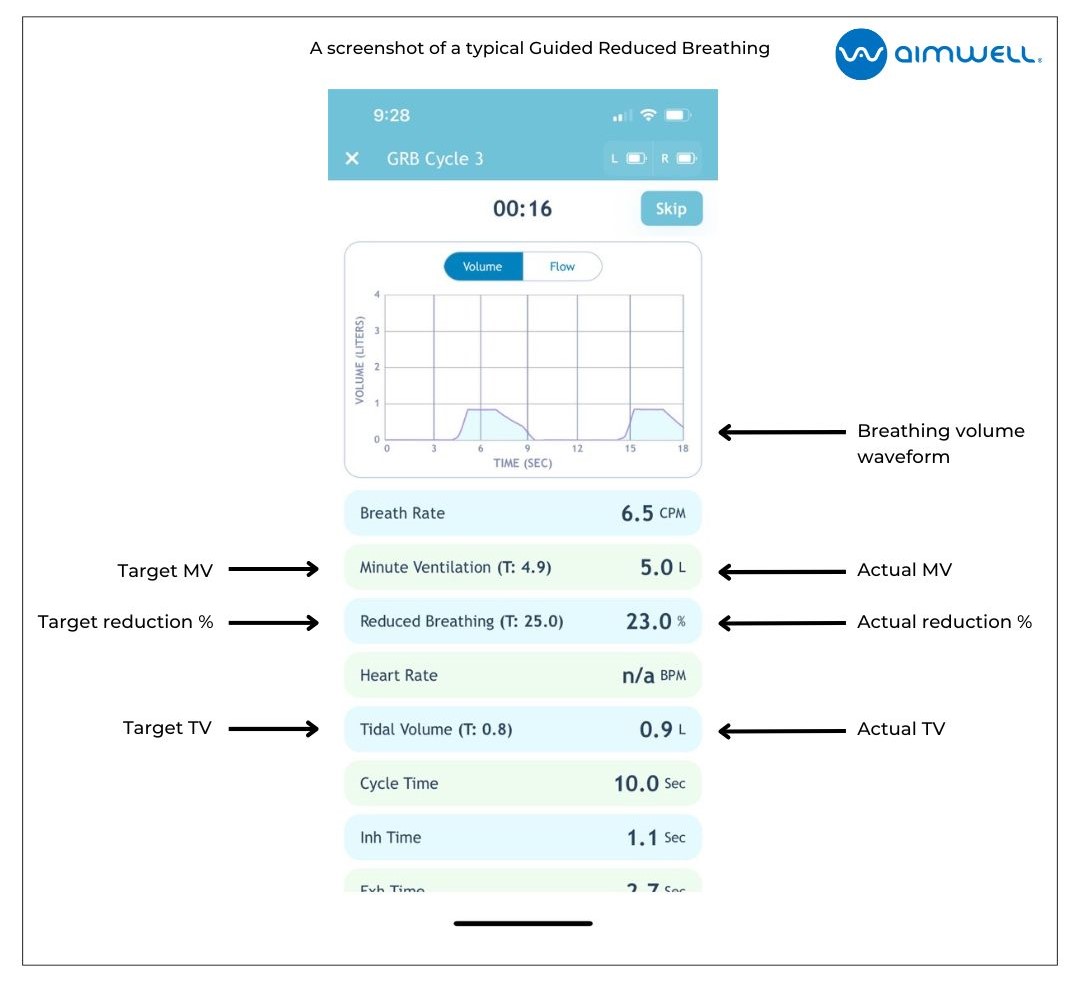
  • During each breathing in and out cycle, based on your target MV and the last cycle time, it displays your target Tidal Volume (TV) for you to breathe toward or to use as a reference cycle by cycle.
  • If you can meet your target TV for each cycle, you should ultimately achieve your overall MV target.
  • Once all the Reduced Breathing cycles are completed, the second Control Pause CP2 comes.
  • Finally, a summary report will provide the key data for the session, such as Initial MV, target MV, actual MV, Reduced breathing ratio (RB%), CP1, and CP2. These data can be saved on your mobile phone and the App server for future reference.

Indications of a satisfactory reduced breathing session include:

  • CP2 at least 5 seconds longer than CP1, meaning your CO2 tolerance after the session has been improved, that is the intended outcome the reduced breathing aims for.
  • Your hands and feet should feel warmer.
  • Your noses should be unblocked (if they were partially blocked before the session)
  • Your breathing should become calmer and quieter, and you should feel more relaxed and comfortable.

The AYO BT+ Guided Reduced Breathing function provides a precise guide and real-time feedback to help achieve reduced breathing volume based on the selected level of air hunger.

The program integrates all key elements from a typical Buteyko Reduced Breathing exercise plus a saveable summary report, which greatly simplifies and automates the practice that would otherwise be time-consuming and troublesome to follow daily.

The real-time breathing volume waveform can also help visualize how well you use and relax your diaphragm, as a tense diaphragm will result in a sharp rising and falling breath that can be shown from the waveform on the App screen, thus it is a great tool for self-learning and practice.

A screenshot of a typical Guided Reduced Breathing

How to Prevent Coughing When Jogging in Cold Air

As a regular jogger, I run a few times in the morning each week, and I found myself coughing lately when the temperature went below 12°C. The cough was more persistent within 30 minutes after the run, and some mucus came out occasionally with the cough. But after that, the cough would disappear, and I would feel quite normal.

Then I realized it must have something to do with cold air. So I decided to do some experiments by wearing the elastomeric exercise mask AYO HC in my run.

Here is the summary result so far:

Date Temperature Distance/Pace AYO HC Coughing Status
Day 1 11°C 5.4K/6:02/km No Yes
Day 2 8°C 4K/6:20/km Yes No
Day 3 7°C 7.1K/5:55/km Yes No
Day 4 9°C 10.8K/6:11/km Yes No
Day 5 3°C 7.1K/5.51/km Yes No

It is very convincing that AYO HC helped me stop the cough.

Here are my thoughts:

  • For some reason (God only knows) I have mucus in my throat that becomes irritated with cold air.
  • During jogging, breathing volume increases, passing more cold air through my airways and making them drier, irritating, and making me cough.
  • When I wear AYO HC, it warms the air before it travels into my airways, and it also brings in the moisture accumulated from my previous breaths.
  • This makes the mucus less irritating. Even better, it dilutes the mucus making it flow out of my nose/mouth naturally removing the source of irritant without coughing!!
  • When we exercise in cold windy conditions, we would put on hoodies to keep our upper body and head warm, tights to keep our legs and knees warm, and gloves to keep our hands warm. However, we often forget about our more sensitive airways!!
  • It is logical and makes perfect sense to wear a proper mask to shield the cold wind from going straight into our airways, to warm and moisten the air before breathing in.

I think many people like me may benefit by wearing AYO HC too in this situation, especially for asthmatics and people with COPD symptoms.

So I recommend that people with sensitive and vulnerable respiratory systems wear AYO HC when exercising outdoors if the air is cold and windy.

AYO HC can also protect you in case of air pollution from wood or coal burning that typically occurs in winter, as AYO HC is a P2 / N95 medical-grade respirator. Due to its low-profile design, great field of view, and elastomeric reusable nature, AYO HC is suitable for many outdoor exercises, such as jogging, cycling, and walking.

Now, you may wonder how I dealt with the mucus flowing out of my nose and mouth when I wore the mask?

I lipped it and swallowed it back to my stomach!!

Gross? I would rather do that than coughing or spitting 😊


About the author:
Eric Fu, founder of Aimwell, exercise enthusiast.

How to Measure Control Pause with Aimwell AYO BT+ Breathing Measurement and Exerciser

How is Control Pause normally measured?

If you have been practicing Buteyko Breathing, you may measure the Control Pause (CP) daily or even multiple times per day.

Indeed, CP is the most important parameter to measure in the Buteyko Method.

According to Dr. Buteyko, the Control Pause or the Buteyko-defined breath-hold time is an accurate and sensitive parameter that normally reflects the tissue oxygenation level in the body at rest.

Research has also indicated a good correlation between CP, minute ventilation, and CO2 level in the body, the three important breathing health metrics, such that if we know one of them, the other two can be more or less correlatedly estimated.

To measure CP correctly, according to the Buteyko Method, do the following:


  • Sit down comfortably with a straight back and all body muscles relaxed, including your breathing muscles.
  • Breathe normally and calmly for 5 minutes – do not breathe more than you need to.
  • Then obtain a watch, breathe in and out normally, and at the end of the exhalation, pinch the nose and start the timer.
  • Keep the nose pinched until the first distinctive urge to breathe, then stop the watch immediately, and the time recorded is the CP. The first such desire often comes with an involuntary and distinctive push of the diaphragm or a pulsing movement in the throat.
  • The first few breaths immediately after the CP should be similar to the breath before the CP.

How does AYO BT+ help measure Control Pause easily with confidence?

 The challenge or tricky bits of performing the CP test following the above guide include some uncertainty about what exactly ‘breathe in and out normally’ is before the breath-hold, how distinctive the urge to breathe at the end of the breath-hold, how to determine if the breaths after the hold are similar to those before the hold. To do all these properly is quite challenging for us humans. We need some tools to help us here.

AYO BT+ Breathing Measurement and Exerciser is designed to measure breathing while performing breathing exercises, and one of its featured exercises in its App is dedicated to measuring Control Pause – a great tool to automate the measurement process and aid Buteyko Reduced Breathing training.

The Control Pause test can be done with either an AYO BT+ Boost, Essential, or Lite as follows:

  • If you use a Boost, connect the L Module on the Left side of the mask, and the E Module on the right side of the mask, then connect the BTo module at the back of the right-side module. Optionally, you can also connect the BTi module at the back of the left-side module for inhalation resistance adjustment.
  • If you use an Essential or Lite, connect the BTo module on the left side of the mask, and the E Module or L Module on the right side of the mask.
  • Power on and wear the device, then open the App.
  • Select “Control Pause” in the “Featured “screen in the App.
  • The test starts with 5 minutes of relaxed breathing, and when the time is up, the App will instruct you to have a normal inhalation, then at the end of a relaxed exhalation hold your breath.
  • Once you stop the hold and start breathing, you will need to breathe for another minute before the App provides the hold time and the capture of breathing waveforms and data before and after the hold for your review.
  • The captured CP data can be saved on your mobile for later viewing.

Note: you can’t pinch your nose when wearing the BT+, however, there is no need to, as if you breathe even slightly, the BT+ will sense it and stop the test immediately.

The following screen capture shows a reference CP reporting screen:

To determine if you performed the CP test correctly, the key is to make sure:

  • The TV adjacent before the hold is similar to the TV Average before the hold.
  • The TV Adjacent after the hold is similar to the value before the hold.

As a rule of thumb, the TV Adjacent after the hold should not be 10% more than that before the hold. If it is, your hold is a bit too long.

If the TV Adjacent after the hold is noticeably smaller than that before the hold, you may have stopped a bit too early, and you can try to hold a bit longer next time.

By measuring like this for some time, you will develop a more accurate sense or feel about what it means to ‘breathe in and out normally” before the hold, the “first distinctive urge to breathe”, and what kind of breath after the hold can be qualified as similar to or not more than 10% of the breath before the hold.

To practice and progress successfully with Buteyko Reduced Breathing, it is important to measure your CP correctly, and AYO BT+ is the first and only tool to date to help achieve it.

How does AYO BT+ help determine if a Positive Maximum Pause is correctly performed?

 Positive Maximum Pause (PMP) is another way to measure breath-hold in the Buteyko Method. In fact, Dr. Buteyko mostly used PMP for his work.

PMP is defined as the maximum length of time you can hold your breath comfortably, and on resumption of breathing force your breathing into the pattern of breathing you had before the breath-hold.

Breathing after PMP is heavier compared with a normal CP, so it is harder to determine if the breath is well-controlled as expected without a tool. For this reason, the BT+ App continues to measure your breathing for 1 minute after you resume breathing, such that even if you can manage the first breath low but fail to control any breaths after that, the measured waveforms can clearly show that as an indication of over-hold.

As an example, the above reference CP screen capture shows well-controlled breaths after the hold, indicating an acceptable PMP measurement.

The following table gives the relationship between CP and PMP:

How to Protect from Welding Fumes Effectively and Economically

How to Protect from Welding Fumes Effectively and Economically

The Health Risk of Breathing in Welding Fumes

Welding fumes are very fine particles of metal oxides, and their composition depends on the type of metal being welded. In addition to the general harm of welding fumes once trapped in the lungs, some metal fumes are particularly hazardous, such as nickel, chromium, and manganese.  Exposure to welding fumes can cause Pneumonia, Metal Fume Fever, Asthma, COPD, cancer, etc. In fact, welding fume-caused cancer is one of the top 10 occupational cancers in Australia.

Nevertheless, welding is one of the most common activities carried out in the industry, such as in shipyards, construction, automotive, aerospace, and maintenance. Hence, a significant number of workers are potentially exposed to welding fumes, and effective actions are needed for their protection.

To address this serious work health issue, the Australian government has implemented a new workplace exposure standard (WES) for welding fumes to better protect workers: from the previous 5 mg/m3 to the current 1 mg/m3.

Options for the Protection

There are two main options:

  • Local Exhaust Ventilation (LEV): Install and use LEV as much as practicable.
  • Use effective Respiratory Protection Equipment (RPE)

The safest and best practice is to have both at the same time.

What Kind of RPE Should Be Used in Conjunction with a Welding Helmet/Lens?

Due to the fine particles from welding fumes, N95-grade disposable masks are considered inadequate.

An elastomeric Non-powered Air-purifying Respirator (NAPR) is better than a disposable mask, as the softer cushion of the elastomeric mask provides a better seal. However, being a negative pressure mask is inherently sensitive to facial leaks thus making the protection still not reliable enough. In addition, most NAPRs have bulky filters on the body of the masks, which may interfere with the lens of the helmet. NAPRs are also uncomfortable to breathe over long working hours, as the filters impose an extra burden to breathe, especially in hot conditions.

The new WES for welding fumes will most likely demand the use of a Powered Air-purifying Respirator (PAPR) to be compliant in many welding sites where LEV measures are either impractical or insufficient.

Lastly, welding fumes are accumulative in the lungs, and the tightened 1mg/m3 limit does not mean it is a safe limit, it is only a legal maximum upper limit to be taken as a starting point. So if welding is part of your regular work, the safest approach is to always wear the best welding mask respirator available.

Considering all the above, a welding helmet in combination with a suitable Powered Air-purifying Respirator (PAPR) is the best option for welding protection. This is because:

  • PAPR has higher protection than negative pressure respirators due to positive pressure inside the mask.
  • Breathing is easier and cooler in hot conditions thus more comfortable to wear doing the tough welding work.

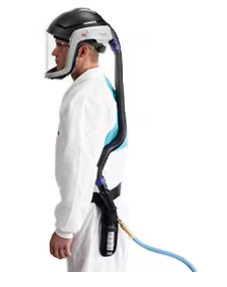
Currently, a popular option consists of a Welding Helmet with an Integrated Loose-fitting Powered Air-purifying Respirator. With this option, the helmet is specially made consisting of a loose-fitting visor for respiratory and face protection, a lens for eye protection, and an air entry at the back of the helmet to receive the air produced by a PAPR that is mounted at the back of the waist and secured by a belt, with filtered air being delivered via a hose to the helmet. A popular brand of this option is a 3M Speedglas G5-01 TW Heavy-Duty Flip-Up Welding Helmet plus an Adflo PAPR unit.

However, there are a few issues with this option: 

  • Protection level is not the highest in class: As it is a loose-fitting PAPR, the nominal protection factor is 500 compared with a tight-fitting PAPR of 2000.
  • Expensive: at a retail price starting over $2,000.
  • If you have a common welding helmet already, adding such a PAPR protection means you have to scrap your old mate: a waste of money and not good for the environment.
  • Troublesome to wear with poor mobility due to the bulky PAPR unit and the long hose at the back.
  • Noisy, as the Adflo PAPR operates at a constant flow, meaning constant annoying noise.

AYO WX HFM-W Welding Half-Face Mask PAPR System – The Perfect Solution for Welding Fume Protection

Invented, designed, and fine-tuned in Australia, AYO WX HFM-W is a state-of-the-art Breath-responsive PAPR that suits welding fume protection extremely well due to the following advantages over the 3M Speedglas – Adflo PAPR system:

  • Best-in-class protection: being a tight-fitting mask, its nominal protection factor exceeds 2000 (PAPR P3) compared to the 3M Speedglas – Adflo Loose-fitting PAPR system of 500.
  • Fraction of the cost: $559 vs >$2,000 for the 3M Speedglas/Adflo system
  • A low-profile half mask designed specifically compatible with most common welding helmets plus a neck-peripheral mounted AYO WX PAPR P3 main unit: beneficial to many welders who currently have a common welding helmet already but now wish to use a PAPR for better respiratory protection.
  • Much improved mobility and comfort: No hose, no belt, and lighter.
  • Aimwell’s intelligent breath-responsive flow control algorithm ensures positive pressure inside the mask at all times with peak flow exceeding 200 L/min while keeping the noise to a minimum during exhalation and late stage of each inhalation.
  • Longer battery run-time: 16 hours vs 3M Adflo PAPR of 12 hours.
  • Service life: >10 years vs 3M Adflo PAPR of 5 years.

In Summary:

Key Comparison 3M Speedglas G5-01 TW Heavy-Duty Flip-Up Welding Helmet with Adflo PAPR (Loose-fitting)

AYO WX HFM-W Welding Half-Face Mask PAPR System

(Tight-fitting or loose-fitting)

Protection Class

EN12941 TH3, MPF: 50

Nominal Protection Factor: 500

AS/NZS 1716 PAPR P3

MPF: > 100 (tight-fitting), 50 (no Fit Testing)

Nominal Protection Factor: 2000 (tight-fitting)

Wearability/Mobility

Heavy with hose and belt, troublesome to don and doff, and poor mobility

Lightweight and low-profile, no hose no belt, easy to don and doff, good mobility


Welding Helmet Integrated Existing non-integrated
Peak flow 170 – 200 L/min > 200 L/min (Breath responsive)
Battery Run-time 12 hours Up to 16 hours
Weight 2.13kg (Helmet 1kg, PAPR 1.1kg) – not including hose) 1.26kg (Helmet 0.54kg (typical), PAPR+half-face mask 0.72kg)
Fit Testing Not required Depending on the level of protection needed
Fitting type Loose-fitting only, can not be converted to tight-fitting PAPR if needed. Tight-fitting but can attach a loose-fitting Face Seal for beard-covering.
Maintenance Difficult to maintain and clean Much easier to maintain and clean
Service life 5 years 10 years
Cost $2195 $559

Aimwell AYO WX HFM-W Welding PAPR P3 – A New Standard in Welding Fume Protection.

Quick Steps to Use AYO WX HFM-W Welding PAPR P3 with a Common Welding Helmet

  • Charge the battery before use.
  • Fit the mask assembly over the face and tighten the strap at the back of the neck.
  • Remove the Guard Link from the Main Unit, wake it up by pressing its On/Off button, then slide the Main Unit down against the back of your head until it rests on the two supporting hooks of the head strap.
  • Push-fit the mask to each end of the Main Unit.
  • Adjust the height of the Hook to ensure a well-balanced support for the Main Unit and the mask.
  • Put on the Welding Helmet and you are ready to weld safely.

What to Wear for Respiratory Protection in Physical Exercises

What to Wear for Respiratory Protection in Physical Exercises

The Use Cases

Physical exercises are fundamental parts of human life, we all need them, no matter whether you are an elite athlete, a weekend warrior, young and old, healthy and sick.

However, these seemingly healthy activities may be compromised if the air we breathe during the activities is poor or even health-threatening.

Typical scenarios include:

  • Working out in a gym during a pandemic or flu season.
  • Running, walking, and cycling in air-polluted cities.
  • Running, walking, and cycling in bushfire seasons.
  • Asthmatics’ outdoor exercises during a pollen season.
  • Asthmatics’ outdoor exercises in a cold and dry winter.

Key Requirements for a Sports/Exercise Masks

  • At least N95/P2 level of particulate filtration.
  • Have a reliable facial seal.
  • Complied with relevant respirator standards.
  • Protection not affected by breath, sweat, and condensation.
  • Reusable and easy to wash and clean.
  • Good field of view.
  • Good wearability and mobility.

Some Typical Masks Claimed to be Sports Mask

Under Armour Sportsmask

Analysis:

  • This is a mask made from synthetic fabric material.
  • Does not protect from viruses/does not comply to any respirator standard.
  • The breathing resistance will increase with breath, sweats, and condensation.

Verdict: This is not a true sports mask.

RESPRO Sportsta™ Mask

Analysis:

  • The breathing resistance will increase with breath, sweats, and condensation.
  • The facial seal is not considered reliable due to the fabric-natured face piece.
  • Does not comply with any respirator standards.

Verdict: This is not a true sports mask.

Reusable Respirator AYO HC – The True Sports/Exercise Mask


The concept for AYO HC started in mid-2020 at the peak of the COVID-19 pandemic. Inspired by a need for better protection for healthcare workers, we spent over 3 years since 2020 developing and rigorously testing the world’s first healthcare reusable respirator AYO HC.

Now certified by BSI to Australian respirator standard AS/NZS 1716 P2, AYO HC provides at least 50 times better protection than disposable N95 masks.


sports mask and exercise mask

What is also outstanding is its features for sports/exercises, such as:

  • Built-in inlet valve to protect the main filter from being affected by breath, sweat, and condensation.
  • Low-profile and great field of view – exercise compatible.
  • See-through silicone mask – easy to see your expression and comfortable to wear.
  • Built-in speech diaphragm – easy to talk.
  • Easy to clean and disinfect.
  • The mask can work as a barrier to cold wind and a warmer/humidifier to cold/dry air – beneficial to asthmatics.

AYO HC is the only true sports mask in the world, your best choice for respiratory protection in physical exercises.

AYO HC Reusable Respirator – A New Standard in Respirator Protection for Sports and Physical Exercises.

0
    0
    Your Cart
    Your cart is emptyReturn to Shop