
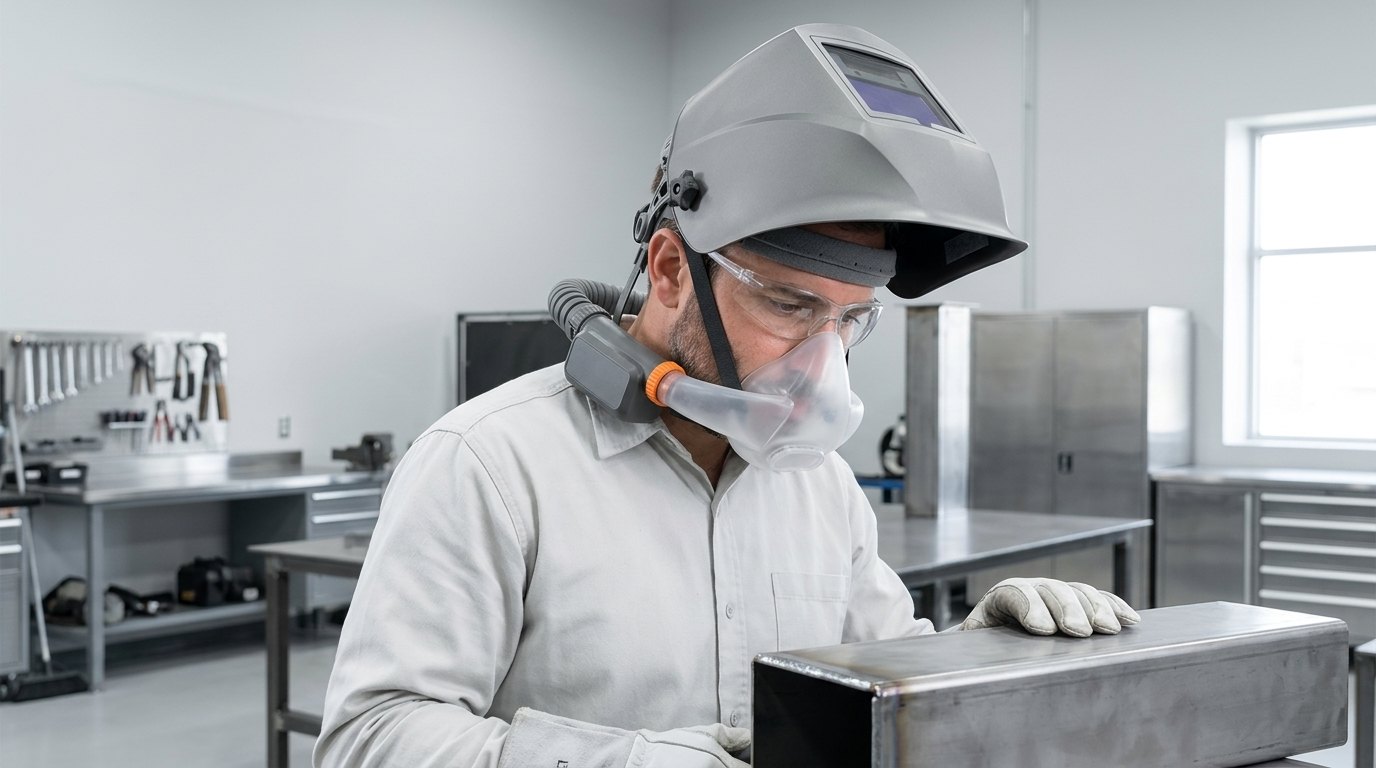
What the 1 mg/m³ limit means for exposure monitoring, control measures and respirator selection.
The welding fume exposure standard in Australia for welding fumes not otherwise classified (NOC) is 1 mg/m³ as an eight-hour time-weighted average (TWA). Employers also need to assess individual fume components and any gases against their own applicable limits. Safe Work Australia explains the current standard.
A lower exposure limit does not automatically make your current respirator inadequate. It does mean you should review whether your exposure controls and selected respirator provide adequate protection for the welding work you do.
This guide explains Australia’s 1 mg/m³ welding fume exposure standard, when air monitoring is required, and what to review when assessing your existing respiratory protection. It draws on national guidance, with clearly identified Victorian examples.
Key takeaways
- Use the current 1 mg/m³ welding fume standard when reviewing exposure to welding fumes NOC, alongside applicable limits for individual contaminants.
- Check monitoring requirements when exposure is uncertain on reasonable grounds or monitoring is needed to assess a health risk.
- Review exposure controls before deciding whether the respiratory protection already in use is sufficient.
- Prepare for the WES to WEL change on 1 December 2026 and check the applicable list with your regulator.
References: welding fumes, air monitoring duties, exposure standards and limits.
What the 1 mg/m³ welding fume standard means
The unit mg/m³ means milligrams per cubic metre of air. An eight-hour TWA expresses exposure averaged over an eight-hour working day, with a 40-hour working week as its reference. A short reading beside a welding bay is not the same measurement. Longer shifts and overtime need appropriate interpretation; an occupational hygienist can advise. See WorkSafe Victoria on exposure standards and monitoring.
Safe Work Australia makes clear that exposure standards are statutory upper limits, not acceptable exposure levels or a guarantee of safety. Welding fume exposure must still be eliminated or minimised so far as is reasonably practicable. For people who weld regularly, respiratory protection should provide an adequate level of protection for the assessed exposure and be suitable for the task and duration of use, alongside effective fume controls. WorkSafe Victoria explains how to select appropriate respiratory protection.
A total-fume result also does not establish compliance for every constituent. The metals, consumables and coatings involved can change the mixture, so the assessment needs to cover relevant individual contaminants. Safe Work Australia describes these separate duties.
When the Australian welding fume exposure limit changed
On 18 January 2024, Safe Work Australia announced that WHS ministers had agreed to reduce the welding fumes NOC standard from 5 mg/m³ to 1 mg/m³. Its notice says the change becomes mandatory when implemented through Commonwealth, state or territory WHS/OHS laws. Check the regulator for the jurisdiction in which the work takes place. Read the national announcement.
Victoria announced that its change took effect on 18 January 2024. Its notice urged employers to reassess their controls. This confirms the Victorian date; it should not be used as proof that every jurisdiction implemented the change on exactly the same day. Read the Victorian announcement.
Aluminium welding fumes have a separate entry. Safe Work Australia’s information sheet gives 17 November 2025 as the reduction date for that entry, also from 5 mg/m³ to 1 mg/m³. Keep this distinct from the January 2024 NOC change. Read the aluminium information sheet.
What changes in December 2026
As at 30 September 2026, the Workplace Exposure Standards (WES) list remains applicable. From 1 December 2026, the Workplace Exposure Limits (WEL) list replaces it. The change includes revised limits for a range of substances, so workplaces should check the entries relevant to their processes rather than treating it as a name change alone. Safe Work Australia’s current transition guidance and WorkSafe Victoria’s explanation set out the timing.
When reviewing welding work, keep the total-fume assessment and the assessment of individual contaminants together. Confirm the applicable requirements with your regulator as the transition approaches.
Why the exposure standard was reduced
Welding fume exposure can damage health over time as well as cause immediate irritation. WorkSafe Victoria’s January 2024 notice lists respiratory irritation, asthma, metal fume fever, nervous-system damage and cancers among the possible effects. Read the regulator’s health explanation.
The reduced standard makes older control assessments worth revisiting. A result below 5 mg/m³ may still be above 1 mg/m³. It does not follow that every respirator selected before 2024 must be replaced; the question is whether the whole control arrangement remains adequate for the current exposure and applicable limits.
What Western Australian mining samples show
A 2025 study by Oosthuizen and colleagues analysed 10,843 welding fume samples collected in Western Australian mining between 1986 and 2024. For the 4,035 samples from 2018–2024, the researchers reported the following comparison. Read the study and Table 3.
- Against 1 mg/m³: 2,814 samples exceeded the standard, or 69.7%.
- Against 5 mg/m³: 865 samples exceeded the former standard, or 21.4%.
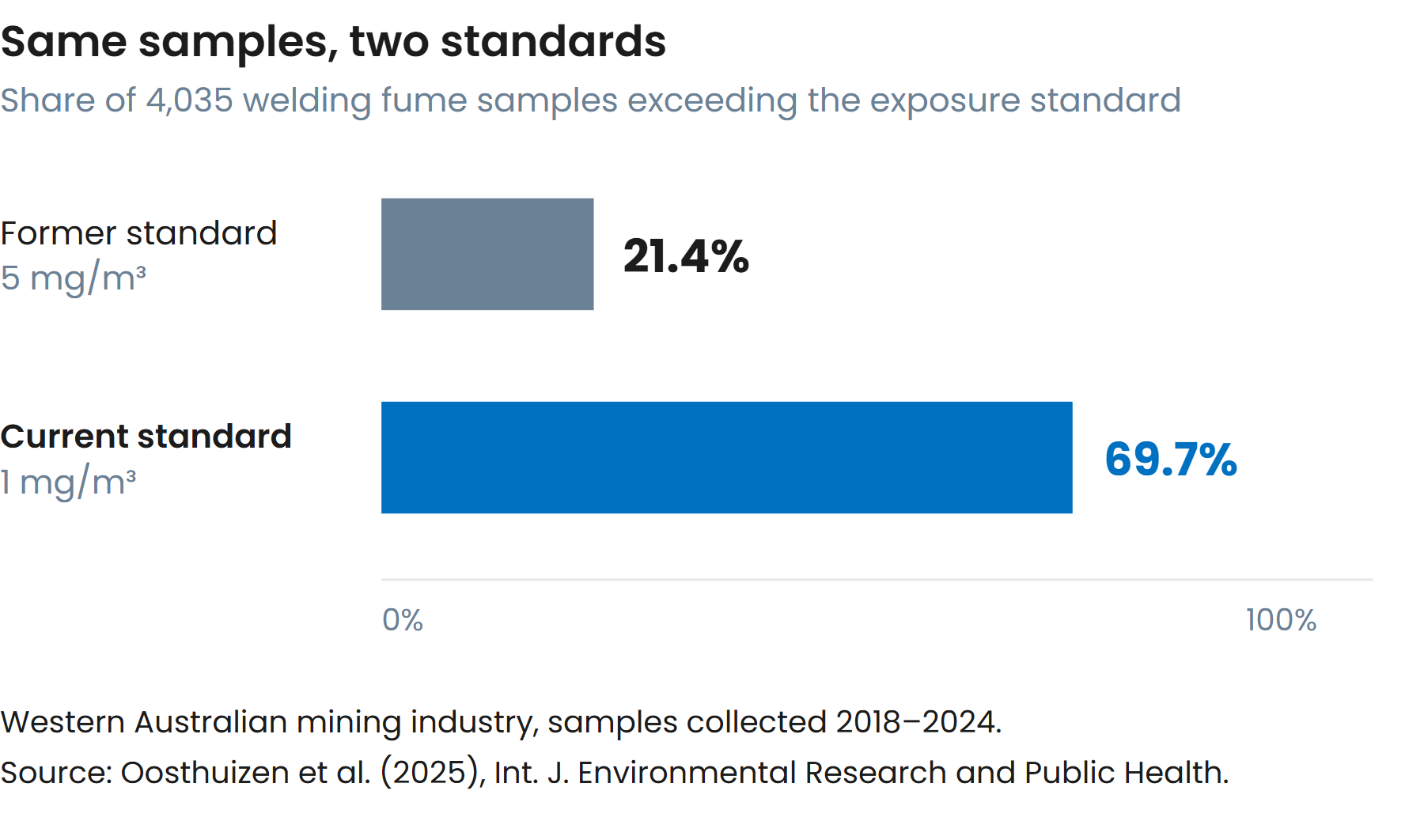
These are historical WA mining samples, not an estimate for all Australian welding workplaces today. The authors also note that sampling outside respiratory protection may not reflect the exposure of a worker who is adequately protected, and other nearby dust sources can affect the samples. The results justify reviewing controls; they do not prove that seven in ten welders are unprotected. Study discussion and limitations.
Welding fume monitoring requirements in Australia
Safe Work Australia describes two triggers for air monitoring where an exposure standard applies: uncertainty on reasonable grounds about whether airborne concentrations exceed the standard, or a need to determine whether there is a risk to health. Monitoring is therefore tied to the exposure assessment, not simply to whether a business owns welding equipment. Read the national air monitoring guidance.
Victoria’s welding guidance identifies a comparable duty under regulation 166 of its OHS Regulations. That regulation number is Victorian and should not be presented as a nationwide provision. Read the Victorian welding guidance.
Use a competent person, such as an occupational hygienist, to plan representative personal sampling and interpret the results. Fixed-position measurements can help investigate conditions in an area, but should not be substituted for personal exposure measurements. WorkSafe Victoria explains the distinction.
Give the hygienist your existing reports, welding processes, materials, consumables, work patterns and current controls. Ask whether the previous measurements still represent today’s work, and which constituents need assessment. Safe Work Australia’s monitoring guidance explains how results help assess control effectiveness.
Which exposure controls to review
Start with opportunities to eliminate welding or reduce fume generation through appropriate process and consumable changes. Review separation of welding work from others and engineering controls, including on-torch extraction or local exhaust ventilation. SafeWork NSW advises that general natural ventilation should not be relied on as the primary control for welding fumes. Read SafeWork NSW’s control guidance.
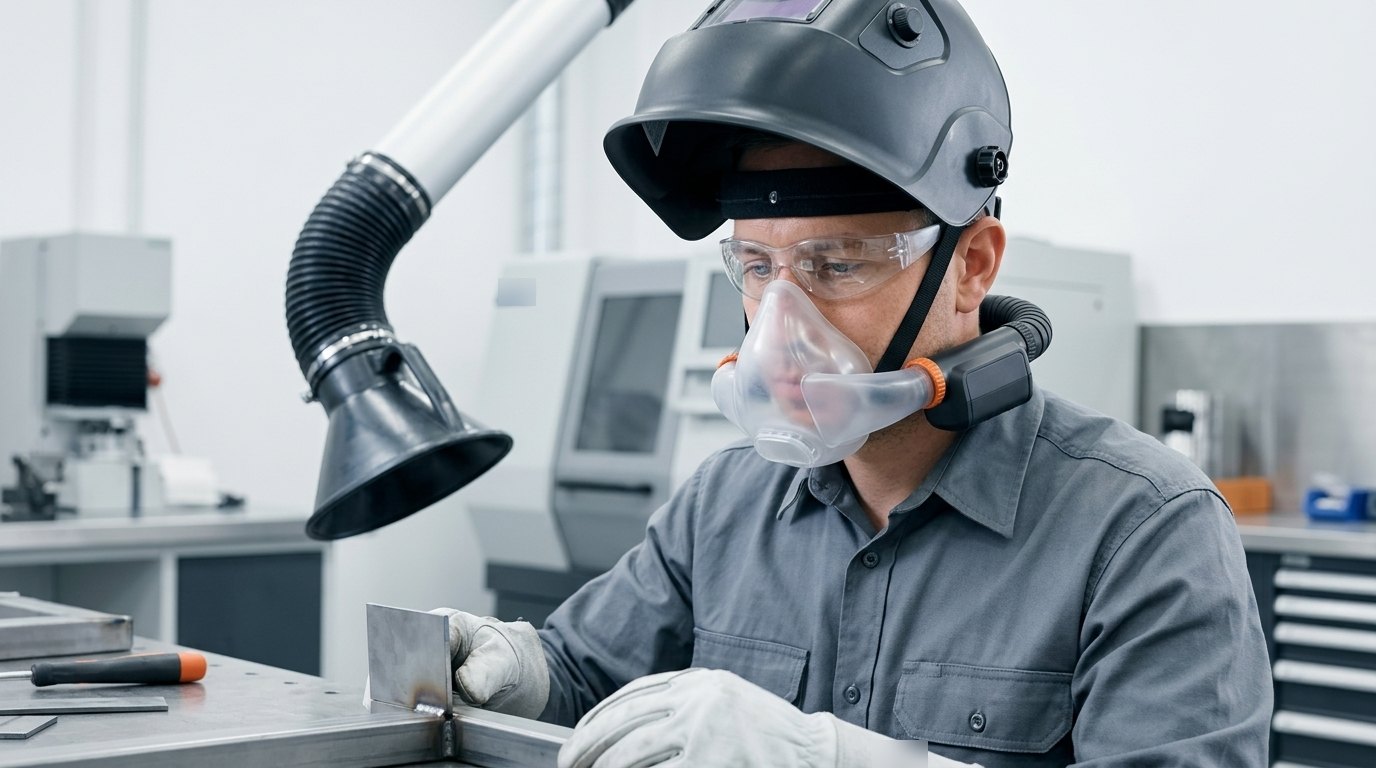
Keep respiratory protection in that wider control plan. WorkSafe Victoria describes RPE as a lower-order measure for supplementing controls, use where higher-order measures are not practicable, or interim protection while those measures are implemented. RPE does not remove fume at its source or protect everyone nearby. Read the Victorian RPE guidance.
To explore how extraction and respiratory protection fit together in practice, read our guide to welding fume protection. It introduces protection options and the AYO WX HFM-W PAPR design, helping you prepare product questions alongside your workplace exposure assessment.
If your assessment calls for a powered respirator for welding, see the HFM-W welding half-mask PAPR for available configurations and product documentation.
How the exposure limit affects respirator selection
A respirator must suit the contaminants, exposure level, task and other controls in place. WorkSafe Victoria’s guidance refers to AS/NZS 1716:2012 or its equivalent and calls for instruction and training in fitting, use and maintenance. Read the regulator’s respirator guidance.
WorkSafe Victoria lists the types of RPE that may be suitable for welding in order of effectiveness:
| Order | Respirator type | What the guidance says about facial fit |
|---|---|---|
| 1 | Powered air purifying respirator (PAPR) | Described as available as part of a welding shield or helmet, and as not relying on a facial fit |
| 2 | Half-face cartridge respirator with P2 or P3 cartridges | “The wearer needs to be clean shaven to ensure a good facial seal” |
| 3 | P2 disposable respirator | “The wearer needs to be clean shaven to ensure a good facial seal” |
A particulate filter alone does not protect against gases such as ozone or nitrogen oxides. SafeWork NSW also distinguishes the fit requirements of tight-fitting respirators. Selection must address the actual facepiece and filter configuration; a general reference to PAPR does not establish that a particular device is suitable. Read SafeWork NSW’s RPE guidance.
Respiratory protection for welders with facial hair
Where facial hair interferes with a tight-fitting respirator’s seal, suitable respiratory protection that does not rely on that seal is needed, such as an appropriate loose-fitting PAPR. WorkSafe Queensland explains facial hair and respirator selection.
The AYO WX HFM-W P-Boost is certified to EN 12941:2023, class TH3 P, as a powered filtering device incorporating a loose-fitting respiratory interface. View the HFM-W P-Boost certificate and its annex. Selection should still account for the welding hazards, required protection level and manufacturer’s instructions.
Considering the AYO WX HFM-W PAPR for your workplace
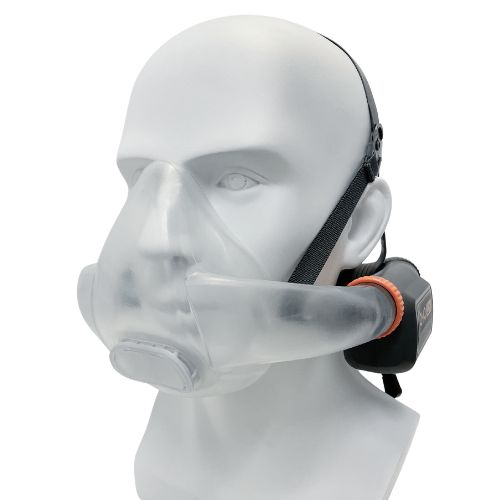
At Aimwell, our AYO WX HFM-W welding PAPR system uses an around-neck main unit without a belt or hose. Its streamlined half-face mask is designed to work with most common welding helmets, allowing welders to retain a compatible existing helmet. Check the fit of the complete combination before selecting it for your team. For a discussion of equipment layout, read our comparison of PAPR wearing arrangements.
 |
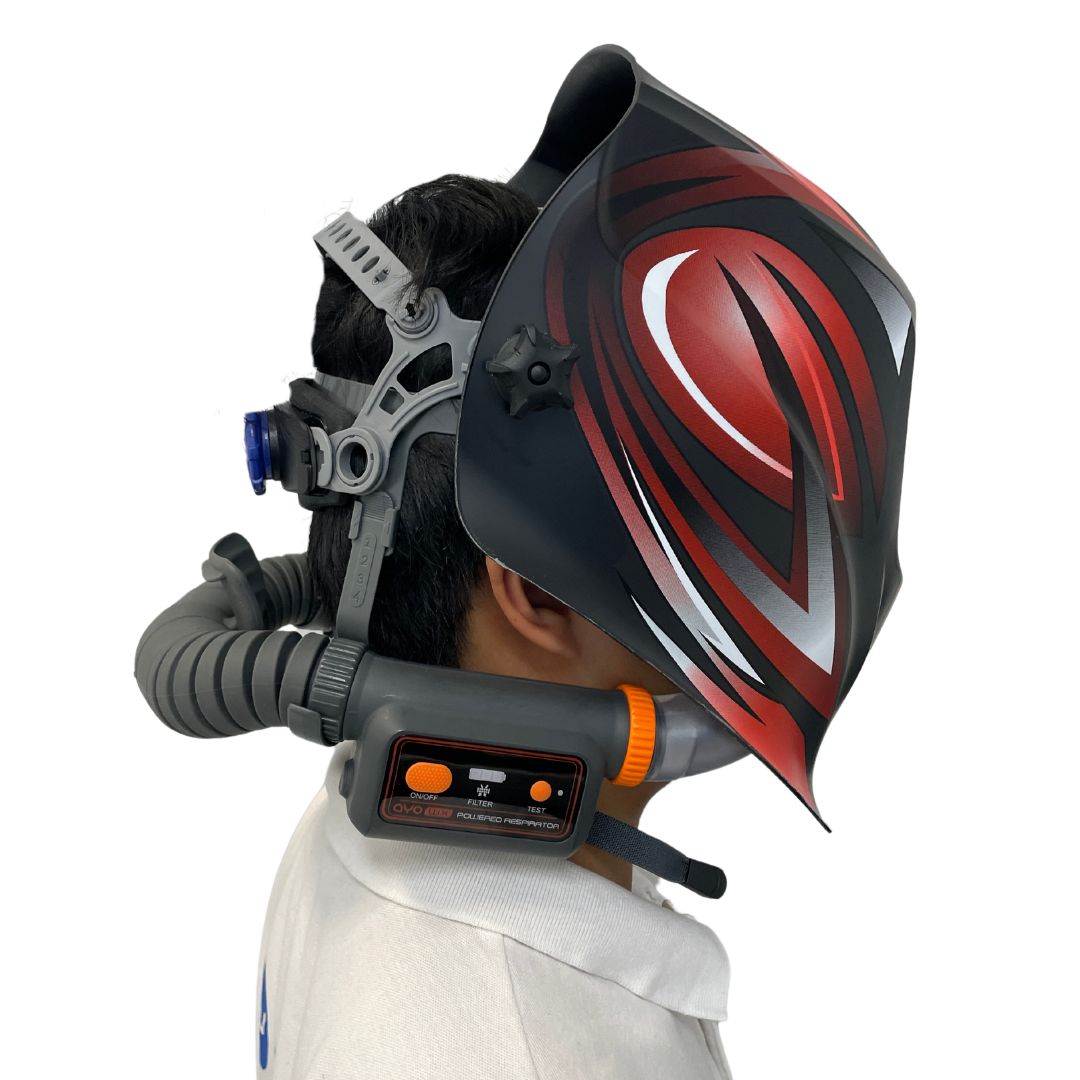 |
The AYO WX HFM-W PAPR range offers two main-unit options. P-Boost uses a pre-filter and a particulate main filter. The Gas option combines a particulate filter with a selected gas cartridge. The distinction matters when an assessment identifies gas or vapour hazards alongside fume particles: cartridge selection must match the identified contaminants and conditions. The Gas name alone does not establish protection against every gas produced by welding.
Use the product page to review configurations and manuals, and consult our AYO WX certification documents for the relevant system. Work through the choice with your occupational hygienist, including facepiece fit, filter suitability, maintenance and training. We can discuss product options once you have identified the protection your work requires.

A practical workplace review checklist
Use these questions to organise your review with the person responsible for workplace safety and your occupational hygienist:
- Do our reports compare results against the applicable current limits, including individual fume constituents?
- Do previous measurements represent our current welding tasks, work patterns and controls?
- Is there uncertainty that requires monitoring, or an identified exposure problem requiring improved controls?
- Have we reviewed extraction and other higher-order measures before relying on RPE?
- Does the selected respirator configuration match the assessment, with appropriate fitting, training and maintenance?
- Have we planned the review of relevant WEL entries before 1 December 2026?
Keep the assessment and resulting actions with your workplace records. Use your jurisdiction’s regulator for legal requirements and a competent occupational hygienist for site-specific exposure assessment. The linked official guidance above provides the basis for this review.
Discuss your welding respiratory protection with Aimwell
Reviewing your respiratory protection following an exposure assessment? View AYO WX HFM-W PAPR configurations and product details, or explore the AYO WX PAPR range. Tell us about your welding processes, helmet, identified contaminants and the findings of your exposure assessment so we can discuss the available configurations with you.
You can also email info@aimwellbreathing.com or call (02) 7251 8689. We can help with product information; your occupational hygienist and workplace safety team determine the protection required for the job.