
Buying a certified PAPR alone does not automatically make your workplace compliant. Under the model WHS Regulations, the duty to train workers in the proper use, wearing, storage and maintenance of respiratory protective equipment sits with the PCBU. That is a separate obligation from the certification the manufacturer holds.
That gap catches out a lot of well-intentioned safety programs. A site buys good equipment, files the certificate, and assumes the box is ticked. A regulator asks for training records, fit test records and a maintenance log, and there are none.
Key Takeaways
- Device certification (AS/NZS 1716) and program compliance (AS/NZS 1715) are different obligations. No product can hold the second for you.
- Model WHS Regulation 44 puts the duty to train, and to keep the equipment usable, on the PCBU.
- Close-fitting respirators need fit testing before first use, on any change of make, model or face, and at least annually — clean-shaven.
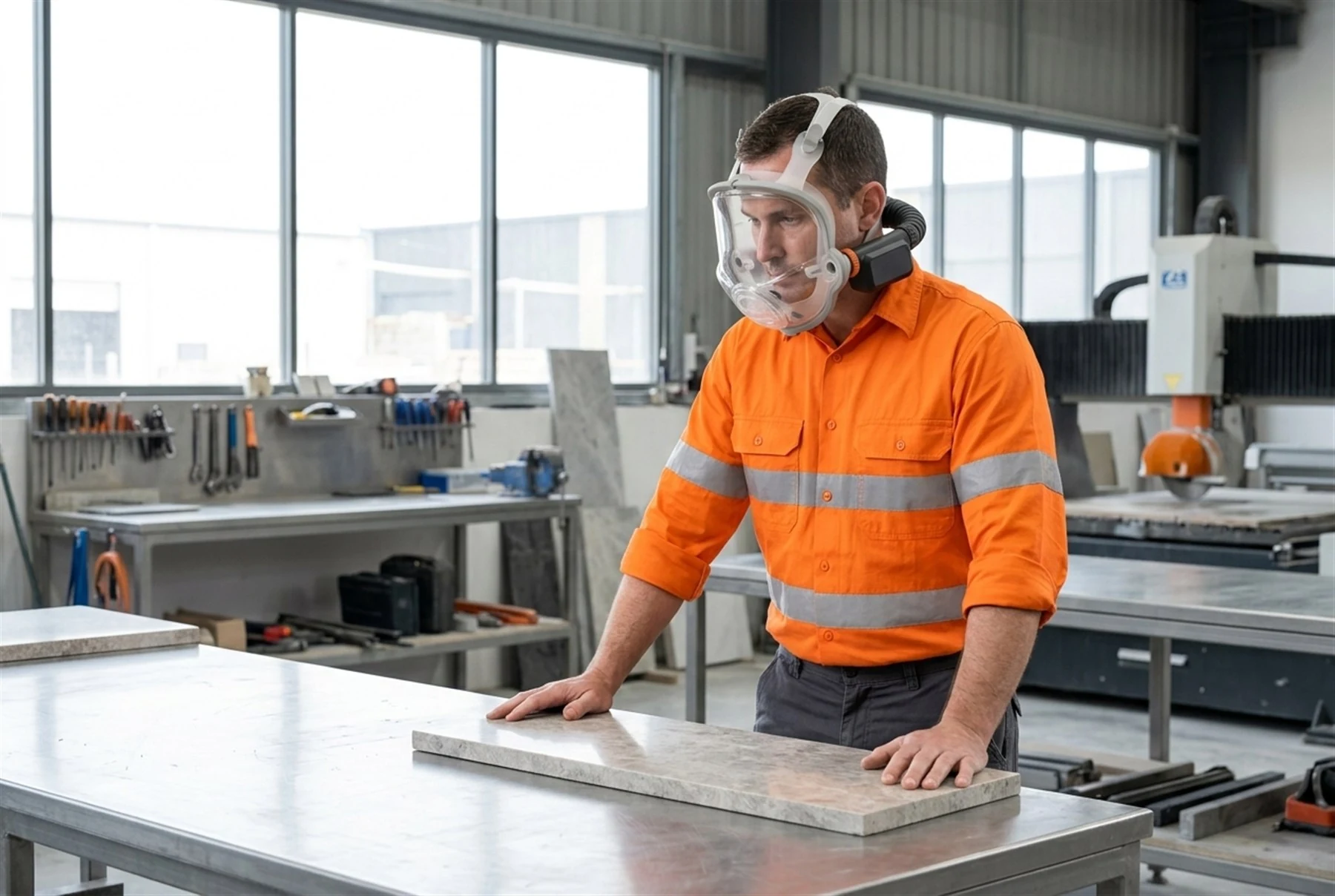
- Fit testing is not required for positive-pressure loose-fitting facepieces — and loose-fitting is not limited to hoods and helmets. A dual-fitting facepiece is certified both ways: worn loose-fitting, no shaving and no fit test; worn tight-fitting, higher protection once it is fitted.
- Name the framework with any protection factor: TH3 is 500 nominal under EN 12941 and APF 40 in the UK. Australia works from a required minimum protection factor under AS/NZS 1715 — a different kind of number, keyed to the facepiece. Never mix the three.
- Welding fume fell to 1 mg/m³ in January 2024. Respirable crystalline silica is 0.05 mg/m³ over eight hours.
Jurisdiction: this describes the model WHS Regulations. Victoria uses its own OHS Act 2004 but adopts the same exposure standards — check each duty separately. NSW-specific duties are marked below.
Does an Australian employer legally have to train PAPR users?
Yes. It is not optional, and it is not satisfied by handing over a manual.
Under the model WHS Regulations, a PCBU that provides personal protective equipment must give workers information, training and instruction in the proper use and wearing of that equipment, and in its storage and maintenance.
Regulation 44 goes further than training. The PPE itself must be:
- Selected to minimise risk to health and safety
- Suitable for the nature of the work and the hazard
- A suitable size and fit
- Reasonably comfortable for the worker wearing it
- Maintained, repaired or replaced so it keeps working
Read that list again with a crew in mind. Reasonably comfortable is a legal requirement, not a nicety. If workers loosen or remove a respirator because it is unbearable in heat or makes communication impossible, the equipment is not minimising risk — and the duty is not discharged.
This is not a theoretical concern. We have written separately on why paper masks and non-powered respirators fall short in high-exertion work, where the wearer’s own breathing effort is the limiting factor.
Which standard sets the training requirement — AS/NZS 1715 or AS/NZS 1716?
| AS/NZS 1716:2012 | AS/NZS 1715:2009 | |
|---|---|---|
| What it governs | The device | Your program |
| Who holds the duty | The manufacturer | The employer (PCBU) |
| Can a product be certified to it? | Yes | No |
| Covers training? | No | Yes |
| Covers fit testing? | No | Yes |
| Covers maintenance and records? | No | Yes |
| What you should ask for | A certificate number | Your own records |
No product can be certified to AS/NZS 1715:2009 — Selection, use and maintenance of respiratory protective equipment. It describes what the employer must do. AS/NZS 1716:2012 certifies the device; Aimwell holds PC10112 to it, issued by CMI Certification Pty Ltd.
A respiratory protection program addresses the whole lifecycle, not just the purchase. SafeWork NSW describes the employer’s obligation as providing “a program to correctly fit, instruct on use and ensure regular maintenance of respiratory protective equipment (RPE)”.
AS/NZS 1715 is not freely available. You will need a copy, or advice from someone who has one, to work to it clause by clause — which is the honest reason so many programs are built on second-hand summaries rather than the text.
The practical test: if a regulator asks how you know a respirator worked on a particular worker on a particular day, the certificate cannot answer that. Your program records can. Certification tells you the device can protect. Your program is what proves it did.
What we put in PAPR training
The regulation requires “information, training and instruction in the proper use and wearing… and its storage and maintenance”. It does not enumerate topics. The list below is the one we use with our own customers — a practitioner’s checklist, not a statutory one:
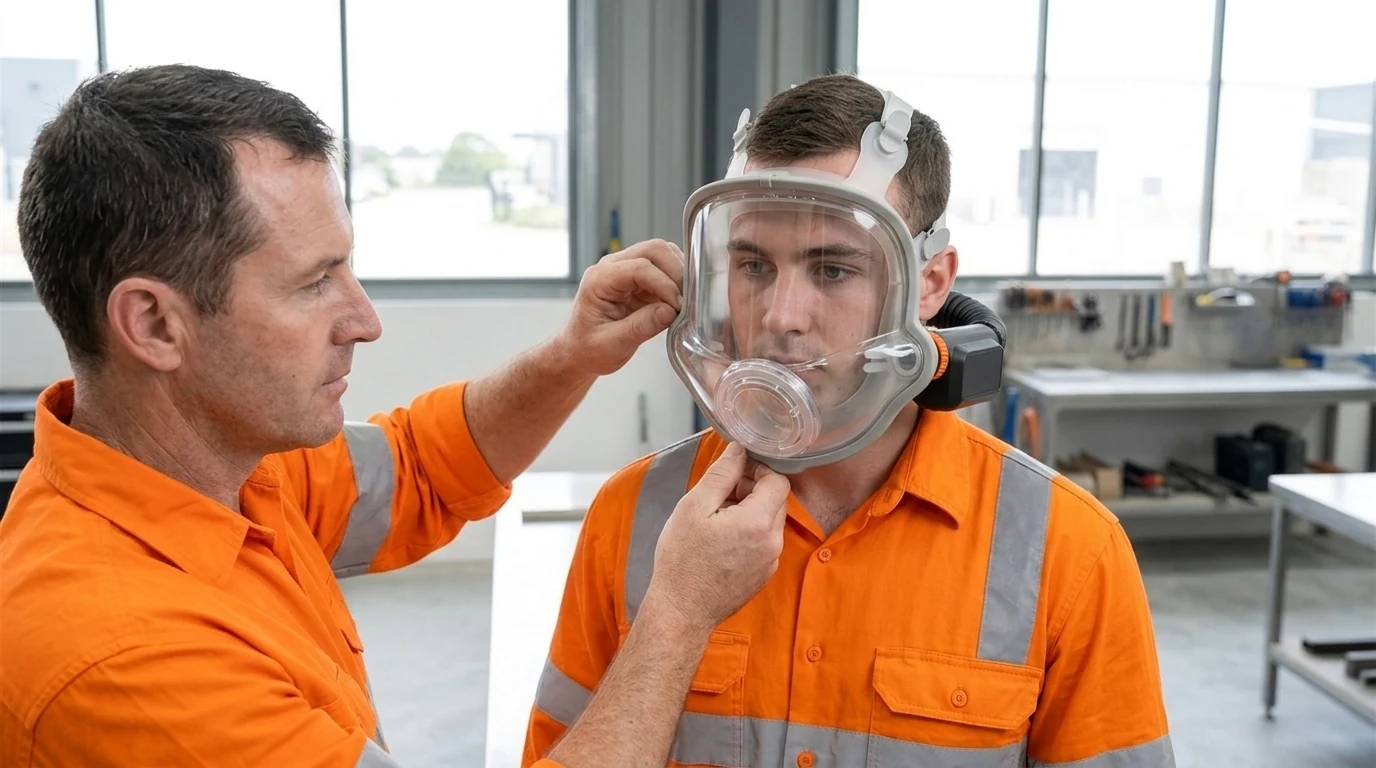
- What the respirator protects against, and what it does not. A P3 particulate filter does not protect against gases or vapours. Workers should know the limit of their own equipment.
- Pre-use checks. Battery charge, airflow check, filter condition and seating, facepiece integrity, breathing duct and connections.
- Donning and doffing. Including how to remove contaminated equipment without contaminating yourself or others.
- Airflow alarms and what to do when one sounds. Leaving the contaminated area is the answer; workers need to know that before it happens.
- Filter and pre-filter change intervals, and how to tell when a change is due.
- Cleaning, storage and battery care. Regulation 44 makes storage and maintenance an explicit part of the training duty.
- Who to report a fault to, and what happens while the unit is out of service.
- How to communicate while wearing it. If crews cannot make themselves understood, they will lift the facepiece. Built-in speech diaphragms help; the AYO WX HFM-SP speech-enhanced system exists for sites where that is the binding constraint.
Review training when the work changes, when new equipment is introduced, or when a worker moves to a different task. It is not a one-off induction item.
Video demonstrations help this stick, particularly for donning, doffing and filter changes. Our AYO™ WX training videos are free to use in your own induction pack.
Does a PAPR need fit testing?
It depends on the facepiece — and this is where PAPRs differ meaningfully from disposable masks.
Tight-fitting facepieces need fit testing. SafeWork NSW states that fit testing must occur:
- Before a close-fitting respirator is worn for the first time
- Each time a new make or model is issued
- Whenever the wearer’s facial characteristics change in a way that may affect the seal
- At least annually
Two further rules apply to tight-fitting equipment:
- Clean-shaven only. “Fit testing must be carried out on workers who are clean shaven or have no hair between their face and the fitting surfaces of the respirator face piece.” SafeWork NSW is explicit that workers who are not clean-shaven above the cheeks, neck and jaw “must not be provided with close fitting RPE as it prevents a good seal”.
- Test method matters. Qualitative fit testing — the pass/fail taste or smell test — “can only be used for half-face respirators”. Quantitative fit testing, which measures leakage instrumentally, can be used for both half- and full-face.
Loose-fitting positive-pressure head tops and hoods are treated differently. SafeWork NSW states the rule in two parts:
“Fit testing is required for all types of close fitting half and full facepiece respirators.”
“Fit testing is not required for positive pressure loose fitting head tops or hoods connected to PAPR or a compressed airline hose.”
The distinction turns on whether the respirator relies on a seal against skin. A close-fitting facepiece does, so it must be individually verified on each wearer. A positive-pressure facepiece normally does not, because the blower produces flow trying to maintain positive pressure inside it instead.
Loose-fitting is not limited to hoods and helmets. That association is a habit of the equipment market, not part of the definition. What makes an interface loose-fitting is the absence of a seal against skin, and nothing in that requires the interface to be a hood — a full facepiece can be built loose-fitting, and is. The ISO classification framework that Australia and New Zealand are adopting — ahead of the United States and Europe, which still work to NIOSH and EN respectively — makes this explicit, treating a loose-fitting interface that covers the whole face as a class of its own, separate from head- and body-level enclosures.
That is a choice you make at purchase, and it decides how much of the program above applies to you. It is also not a binary. The two facepieces below are the two ways of getting there.
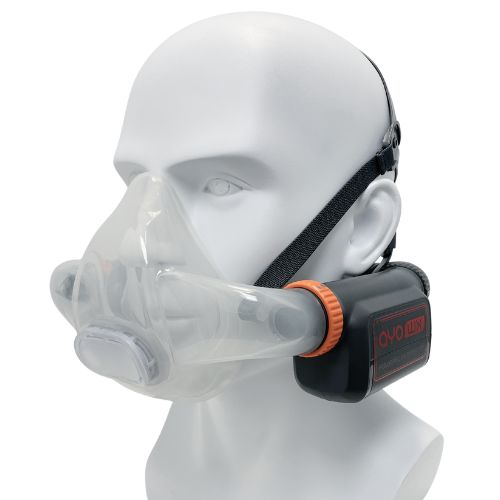
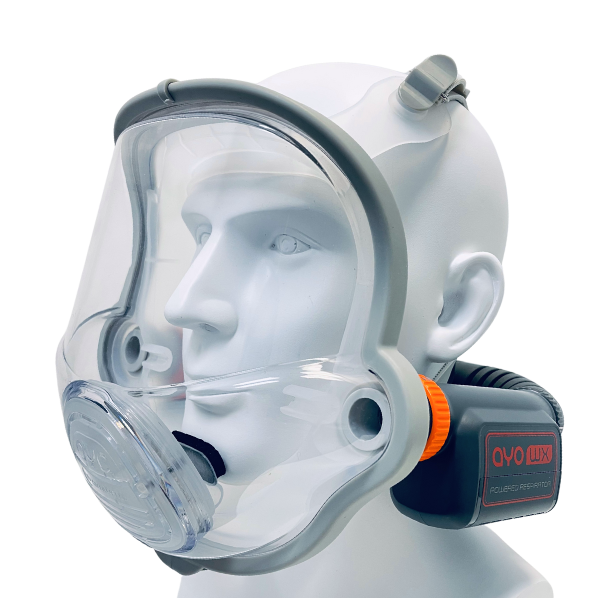
Loose-fitting, dual-fitting, and what each one takes out of your program
The AYO WX FFM-LF is loose-fitting. The AYO WX FFM-LF P-Boost is certified to EN 12941:2023 at class TH3, the highest class in that standard, as a loose-fitting full facepiece. Nothing seals against skin, so there is no fit test and no requirement to shave.
The AYO WX HFM and HFM-W are dual-fitting. They are certified to both the loose-fitting and the tight-fitting standards, and the wearer picks the mode:
- Worn loose-fitting — no shaving, no fit test.
- Worn tight-fitting — higher protection once it is fitted properly, and in that mode every tight-fitting rule above applies in full: clean shaven, fit tested, on record.
That is what dual-fitting buys you. One facepiece covers a bearded contractor on a two-day job and a clean-shaven operator on a high-exposure task, without running two fleets and two sets of paperwork.
Ask any supplier to be this specific, and to state the operating conditions with it. Ours are four:
- Loose-fitting protection is at least 40× a well-fitted P2 mask on a clean-shaven face — a ratio of nominal factors (TH3 = 500 under EN 12941, P2 = 12.5 under EN 140), not an assigned protection factor and not a figure an employer may claim.
- Match the class to your contaminant’s exposure limit. Selecting a level of protection against a measured exposure is the employer’s duty under AS/NZS 1715, and it stays there whichever facepiece you buy.
- Charge the battery fully before a long or hard shift.
- Do not run a blocked filter; replace more often in heavy dust.
The same device carries three different protection numbers
| Framework | Figure for TH3 | What it is |
|---|---|---|
| EN 12941 (European device standard) | 500 | Nominal protection factor — a laboratory classification of the device |
| AS/NZS 1715 (Australian program standard) | Set by the facepiece, not by the European class | Required minimum protection factor — the reduction needed to bring the wearer below the exposure limit, assuming a clean-shaven, fit-tested and trained wearer. The device-class figures are in Table 4.6, §4.2.7 |
| UK HSE | APF 40 | Assigned protection factor — what a UK employer may claim in a risk assessment |
The number that governs your control decision comes from your own jurisdiction’s program standard. In Australia that is AS/NZS 1715, and it works from a required minimum protection factor — the measured airborne concentration divided by the exposure limit. That ratio is what decides which class of device a task needs.
Two things follow. The European 500 is a device classification, not a licence to work to 500. And the Australian mapping from a required factor to a device class is keyed to the facepiece, not to the European class — and it assumes a clean-shaven, fit-tested, trained wearer, which is the whole subject of this article.
We are deliberately not reproducing the device-class figures here. They are widely misquoted online, the most common error being to mix an Australian required protection factor with a European nominal one. Take the mapping from AS/NZS 1715 Table 4.6 (§4.2.7) itself, or from a certified occupational hygienist who has your exposure data in front of them.
Positive pressure is a condition, not a guarantee. It depends on the blower delivering adequate flow. At high work rates, or on a depleted battery, that margin narrows — which is precisely why airflow checks and alarm response belong in your training, and why battery and filter maintenance are program duties rather than housekeeping.
This is not only a protection question — it is an administrative one. Future Form, a formwork and concrete construction company, moved to loose-fitting PAPRs partly because high contractor turnover meant repeated fit testing on every new starter. Greg Rogers, their WHSE Manager, reports the change saved more than eight hours a month in administrative time and testing costs (Future Form case study). For a business with churn, fit testing is a recurring onboarding cost, not a one-off.
None of this removes your other obligations. Training, maintenance, records and health monitoring apply regardless of facepiece type. But if fit-test failures are driving your program’s cost and downtime, facepiece type is the variable worth examining. The facial hair question is more complicated than “shave or don’t”, and we have covered when a worker needs to shave and when they do not in detail.
The silica rules changed in September 2024
Since 1 September 2024, stronger regulation of crystalline silica substances has applied across all industries under the model WHS Regulations — not just engineered stone.
The workplace exposure standard for respirable crystalline silica is 0.05 mg/m³ averaged over eight hours, or an adjusted figure for extended shifts such as 12-hour rosters.
Two record-keeping duties follow, and both are commonly missed:
- Air monitoring records must be kept for 30 years, and results must be provided to workers.
- In NSW, since 1 September 2024, air monitoring results that exceed the WES must be notified to SafeWork NSW within 14 days of receiving the report. Check the equivalent notification duty with your own regulator.
Health monitoring is required where there is a significant risk to a worker’s health from ongoing RCS exposure — and critically, workers who rely on respiratory protective equipment as a control must be included in the health monitoring program. Issuing a PAPR does not take a worker out of scope. In many cases it puts them in scope.
The welding fume limit fell 80% — and that triggers your training duty
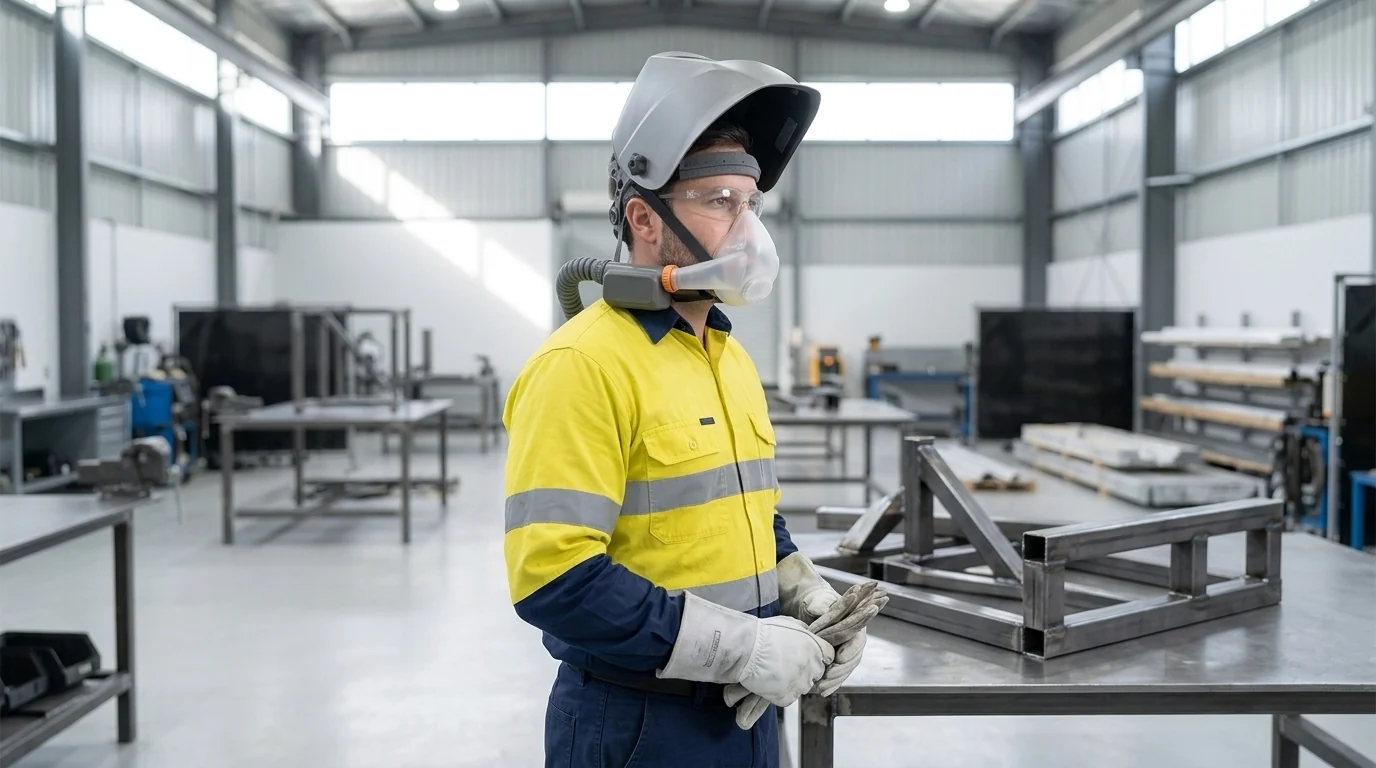
The standard fell from an eight-hour time weighted average of 5 mg/m³ to 1 mg/m³ for welding fumes not otherwise classified, following a decision by WHS ministers. The limit applies not only to welders but to other workers near them.
This one does apply in Victoria. WorkSafe Victoria confirms the same 1 mg/m³ standard took effect there on 18 January 2024 — a state can sit outside the model WHS framework and still adopt the same exposure standards.
Weld Australia’s recommended control hierarchy puts local exhaust ventilation first — hooded or on-gun extraction at the source. Where welders work in or near the plume, it names powered air-purifying respirators and externally air-fed helmets as the personal protection of choice.
If you moved welders onto PAPRs after the standard changed, that is a new make and model for every one of them — which triggers the training duty and, for tight-fitting facepieces, a fresh fit test.
The welding-specific system in our range is the AYO™ WX HFM-W P-Boost, designed to sit under an existing welding helmet rather than replace it.
How do you check a PAPR is actually certified for Australia?

CE marking is not Australian certification. They are separate schemes, with separate bodies, separate certificate numbers and separate expiry dates. A respirator can legitimately carry a CE mark and still not hold AS/NZS 1716 certification.
Ask any supplier for these five things. A compliant supplier will have them ready.
- The certificate number, not a logo on a brochure.
- The certification body, and its accreditation. In Australia, look for JAS-ANZ accreditation and operation to ISO/IEC 17065.
- The expiry date. Certificates lapse.
- The model and part numbers listed on the certificate — and check that the item you are quoting matches one of them, size included.
- A public verification route, so you are not relying on a PDF the supplier sent you.
For our own equipment, those answers are: AS/NZS 1716:2012 certificate PC10112, issued by CMI Certification Pty Ltd (JAS-ANZ accreditation No. Z4450210AK, operating to ISO/IEC 17065), certified 2 December 2024 and valid to 1 December 2029, verifiable at register.cmicert.com.au. The AYO™ WX full-face systems additionally meet AS/NZS 1337.1:2010 Medium Impact for eye protection.
Three AYO™ WX systems separately hold EN 12941:2023 TH3 P EU Type-Examination certificates (CCQS, Notified Body 2834) — downloadable from our certificate library, with part numbers that match the configurations listed in the AYO™ WX around-neck PAPR range. The dual-fitting facepieces are certified to EN 12942:2023 at TM3 as well, the tight-fitting equivalent, which is what lets them be worn either way.
The records a regulator will ask for
The regulations and the silica record-keeping duties above account for most of these. The rest are what we have seen inspectors actually ask for. Again, our checklist — not a statutory list:
- The name of the program administrator
- Hazard assessment and the RPE selection rationale for each task
- Training records, per worker, with dates and content covered
- Fit test records for tight-fitting equipment, with method, result and date
- Issue records showing who holds which unit
- Maintenance, cleaning, filter change and battery service logs
- Air monitoring results — retained 30 years for RCS — and evidence they were provided to workers
- Health monitoring records for workers relying on RPE as a control
- Program review dates and what changed as a result
Most sites have the equipment and half the paperwork. The half that is missing is usually training records and maintenance logs.
Frequently asked questions
What should a fit test record actually contain?
There is no publicly published statutory template for this. Based on what we see requested in practice, record at minimum: the worker’s name, the date, the make, model and size tested, the test method used (qualitative or quantitative), the result, and who conducted it. Keep it retrievable per worker, because that is how it will be asked for. A test with no record is, for compliance purposes, a test that did not happen.
Who can conduct fit testing?
Our reading of AS/NZS 1715:2009 is that it expects a competent person. There is no single national licence, so competence is something you have to be able to demonstrate — through training records for the tester, the method used, and equipment calibration where quantitative testing is involved. Ask any external provider for those three things before booking.
Where to start
If you are auditing an existing program, start with the two documents most often missing: per-worker training records, and the maintenance log. Equipment is usually the part that has been done properly.
Specifying new equipment? Get the certificate number and the model list before you compare prices — and check whether a loose-fitting or dual-fitting facepiece removes a fit-testing problem you have been managing for years. Our view on why the industry over-indexes on the fit test is set out in is fit testing for respirators a flawed practice?
Aimwell manufactures the AYO™ WX PAPR range. For the full certificate, the part number schedule, or our training materials for your induction pack, get in touch — and if you are in NSW and eligible for the SafeWork rebate, we have configured a $1,000 PAPR bundle to match it.
About the author
Eric Fu is Managing Director of Aimwell Pty Ltd (ABN 68 652 924 957), an Australian respiratory protection manufacturer headquartered in Sydney. Aimwell designs the AYO™ WX powered air-purifying respirator range in Sydney and manufactures it in its own ISO 9001-certified facility in China.
I wrote this because the certification-versus-compliance distinction is the question we field most often from safety managers, and the answer is rarely stated plainly anywhere — including, too often, by suppliers.
This article describes regulatory obligations in general terms and is not legal advice. Requirements vary between states and territories. Confirm your duties with your WHS regulator. Figures and regulatory positions checked 7 August 2026.